
Why Simple Rooflines Often Outperform Complex Homes
When people think about quality construction, they often focus on materials. Hardwood flooring. Stone countertops. Premium siding. High-performance windows. While materials certainly matter, one of the most important factors affecting a building's long-term durability is something many homeowners rarely consider:
The roof.
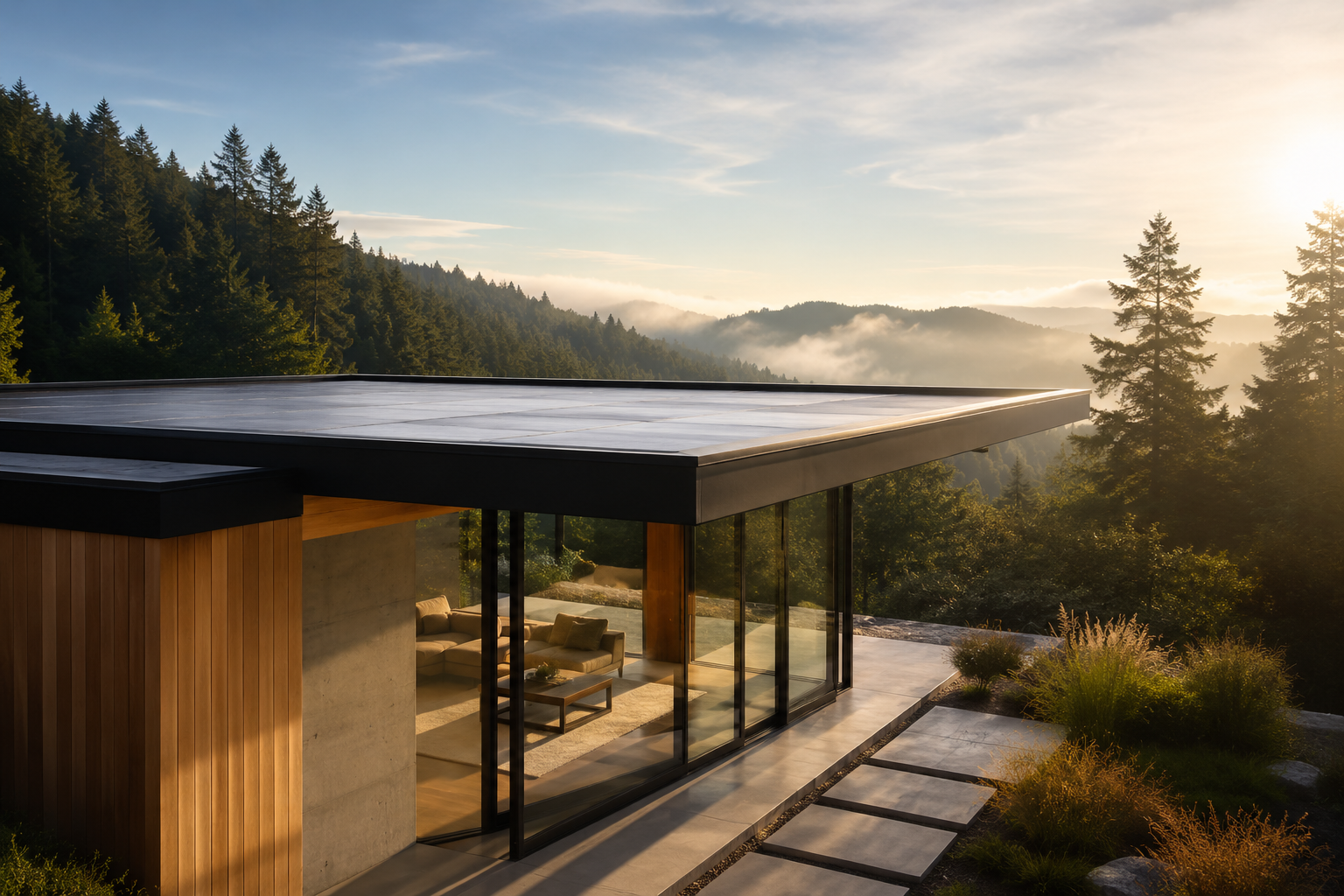
A simple roofline does not have to be ordinary. Many of the most successful residential designs rely on clean geometry, thoughtful detailing, and careful water management rather than increasingly complex roof forms.
More specifically, the shape of the roof.
Throughout history, some of the most durable homes, barns, churches, and civic buildings have shared a common characteristic: relatively simple roof forms. Whether it's a traditional Craftsman bungalow in Portland, a New England farmhouse, an Irish stone cottage, or a Scandinavian timber structure, these buildings were often designed with one primary goal in mind:
Move water away from the building as efficiently as possible.
Looking to protect your investment?
Early design decisions can have long-term impacts on durability, maintenance costs, and construction risk. Experienced owner's representation can help identify potential issues before construction begins.
As simple as that sounds, some of the most celebrated architects and buildings in history have struggled with roof performance while pushing architectural boundaries.
Frank Lloyd Wright's Fallingwater is famous for its dramatic cantilevers and seamless integration with the landscape, yet it experienced persistent water intrusion issues throughout its history. Le Corbusier's Villa Savoye, one of the defining works of modern architecture, also developed leakage problems associated with its pioneering flat roof design.
These buildings changed architecture as we know it and continue to be admired for their design innovation, spatial qualities, and cultural significance. Their roofing challenges do not diminish their architectural importance. However, they do raise an interesting question:
Is a dynamic multi-peaked roof the best way to create great architecture?
During my years working in forensic architecture and construction defect litigation, I often found that some of the most expensive building failures began where roofs became unnecessarily complicated.
Roof design decisions made during schematic design can have long-term impacts on durability, maintenance costs, and construction risk. Understanding those risks early can help avoid expensive problems years later.
Water Always Wins
Building science has evolved dramatically over the past century, but one principle remains unchanged:
Water is persistent.
Given enough time, water will exploit nearly any weakness in a building envelope. Successful roof design is not about preventing water from ever touching a building. It is about controlling where that water goes and ensuring it leaves quickly.
This is one reason many historic structures have survived for generations. Their builders understood that rain, snow, and moisture were not occasional events. They were constant design considerations.
Simple roof forms naturally shed water more effectively because they create fewer opportunities for water to slow down, collect, or penetrate the building envelope.
Every Roof Feature Comes With a Cost
Modern homes often feature:
Multiple roof ridges
Valleys
Dormers
Intersecting gables
Roof decks
Complex overhang transitions
Decorative roof elements
Many of these features can be incorporated successfully, but each introduces additional complexity.
Every valley requires flashing.
Every dormer creates additional intersections.
Every roof penetration creates another potential leak location.
Every transition increases installation complexity.
None of these elements are inherently bad. The challenge is that every added feature increases both construction risk and long-term maintenance requirements.
The most durable roof is often not the most elaborate one.
Construction Reality
A simple gable roof may have only a handful of critical flashing locations.
A complex roof with multiple dormers, valleys, roof decks, and intersecting gables can easily contain dozens of flashing transitions, each requiring proper detailing, installation, and maintenance.
The challenge is not that complex roofs cannot perform well. Many do. The challenge is that every additional transition creates another opportunity for water intrusion if the design, installation, or maintenance is less than perfect.
Why Historic Homes Often Kept Roofs Simple
Many traditional building styles evolved in response to climate.
Builders did not have modern waterproof membranes, synthetic underlayments, advanced sealants, or highly engineered flashing systems. They relied heavily on geometry and detailing.
A steep gable roof sheds water quickly.
A simple ridge minimizes transitions.
Generous overhangs protect walls and windows.
The roof itself becomes the first and most important line of defense.
You can see this principle throughout traditional architecture around the world. The specific styles vary, but the underlying strategy remains remarkably consistent: create a roof that encourages water to leave the building as quickly as possible.
The result is often a structure that remains serviceable for decades with relatively modest maintenance.
The Hidden Cost of Roof Complexity
One of the challenges with complex roof designs is that the consequences are rarely immediate.
A home may perform perfectly well for its first ten years or more. The problems often emerge slowly.
A flashing detail begins to deteriorate.
Debris accumulates in a valley.
Sealants reach the end of their service life.
A product is installed in an application where it is exposed to excessive heat, ultraviolet radiation, or movement beyond its design limits.
Learn why movement is not a bad thing for buildings, check out our article:
Why Old Timber Buildings Last: Lessons in Joinery and Movement
Flashing joints that initially performed well begin to separate after years of seasonal expansion and contraction. Small gaps develop. Water finds a pathway.
By the time interior damage becomes visible, moisture may have been present for months or even years.
In many forensic investigations, the original problem was not poor workmanship. The issue was often a complicated construction detail, an overlooked transition, or a product specification that gradually became a failure point within the building envelope.
The more complex the roof, the greater the number of locations that require ongoing attention.
Simplicity Is Not Boring
Planning a Custom Home or Major Remodel?
Great architecture is about more than appearance. The most successful homes balance aesthetics, durability, constructability, maintenance, and long-term performance. Decisions made during the earliest stages of design can influence how a home performs for decades.
Whether you're planning a custom home, major addition, historic renovation, or property redevelopment project, JR-DBA provides residential architectural services focused on thoughtful design, practical construction solutions, and long-term building performance.
One common misconception is that simple rooflines limit architectural character.
Historically, many of the most admired homes were built around straightforward roof forms.
Philip Johnson's Glass House and E. Stewart Williams' Twin Palms residence demonstrate how clean geometry and disciplined design can create iconic architecture without relying on excessive roof complexity.
Craftsman homes often relied on simple gables combined with thoughtful detailing and craftsmanship.
Traditional farmhouses used uncomplicated roof geometry supported by strong proportions and durable materials.
Many of the world's most enduring residential designs achieved their beauty through scale, materials, craftsmanship, and detailing rather than increasingly complicated roof forms.
Good architecture does not require unnecessary complexity.
In many cases, restraint creates a more timeless result.
"The buildings that endure are rarely the ones that fight their climate. They are the ones designed around it."
What This Means for Homeowners
This does not mean every home should have a basic rectangular footprint and a single gable roof.
Architecture is always a balance between aesthetics, function, site conditions, budget, and performance.
However, homeowners should understand that complexity carries consequences.
More roof intersections generally mean:
Higher construction costs
More flashing requirements
More maintenance
Greater potential for water intrusion
More difficult future repairs
When evaluating a custom home, addition, or major remodel, it is worth asking whether each layer of complexity is providing meaningful value.
Sometimes it is.
Sometimes it is not.
If you're considering a new home design, planning a renovation, or evaluating an existing property, one of the most valuable questions to ask is not whether a design looks impressive today, but whether it will continue performing twenty or thirty years from now.
The Bigger Lesson
Many of the buildings that have survived for generations share a common trait: they embraced simple solutions to complex problems.
Historic builders understood that they could not control the weather, but they could control how their buildings responded to it.
A well-designed roofline is one of the clearest examples of that philosophy.
The goal was never to create the most complicated building possible. The goal was to create a building that would continue performing decades after construction was complete.
Today, that lesson remains just as relevant.
Good design is not always about adding more.
Sometimes it is about knowing what can be left out.
Great architecture balances aesthetics, performance, constructability, and long-term durability. Whether you're evaluating a custom home, addition, historic renovation, or complex residential project, early design decisions can have lasting impacts on maintenance costs and building performance.
Contact JR-DBA to discuss Residential Architecture, Owner's Representation, or Early Project Feasibility Services.
JR-Design Build Architect
Architectural Design • Owner's Representation • Construction Management Advisory
