
What an Owner’s Representative Actually Does — and Why It Matters Before Breaking Ground
What Does an Owner’s Representative Actually Do During Design and Construction?
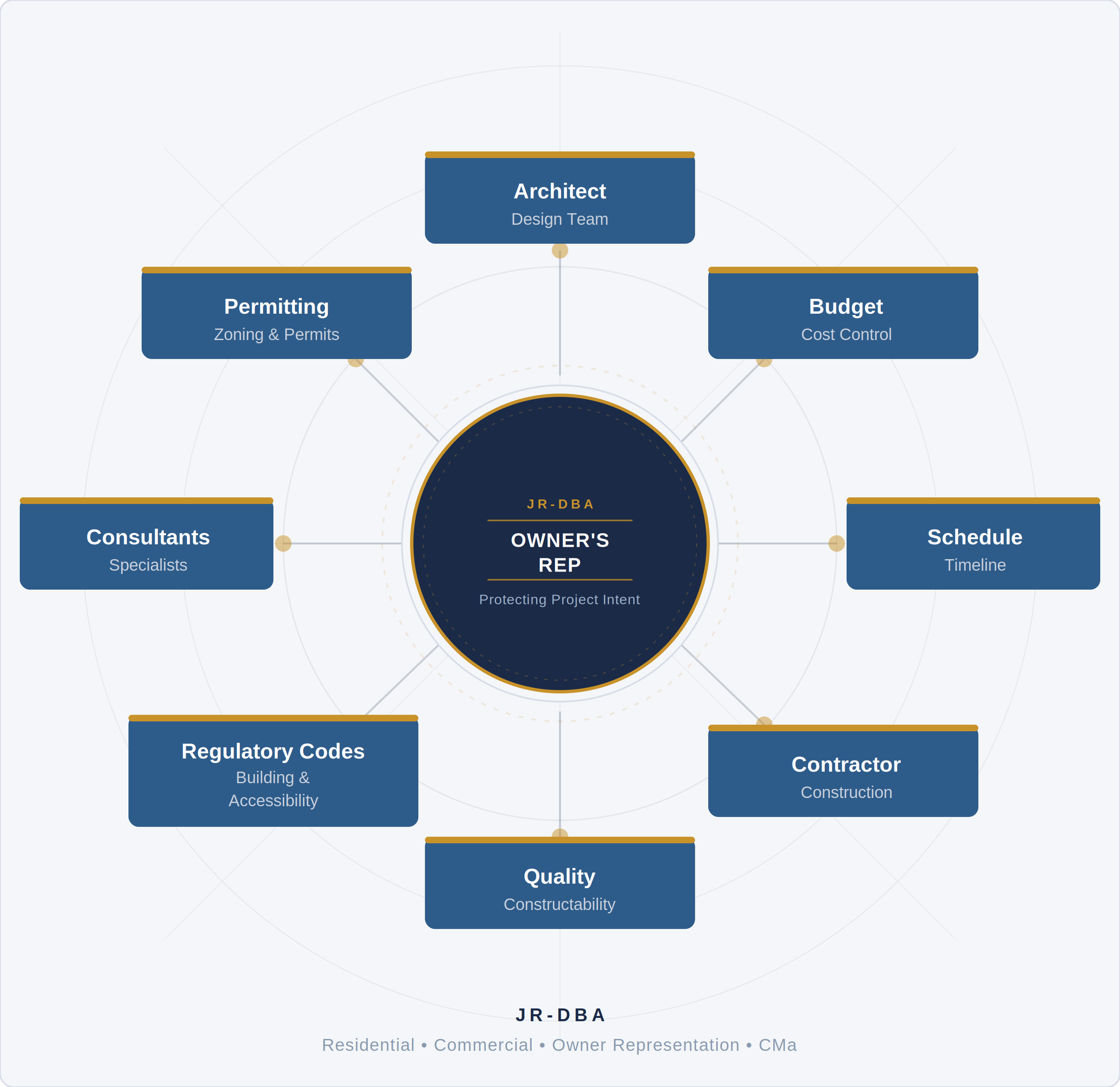
An owner’s representative helps align design, permitting, budget, quality, and construction priorities around the owner’s goals.
Early coordination between owner, design, and construction teams is where outcomes are determined.
Most construction projects begin with a clear vision.
A homeowner imagines a transformational remodel that finally brings their home in line with how they want to live. A business owner pictures a tenant improvement that supports growth. A church or commercial property owner plans a renovation that better serves its community and mission.
The budget feels reasonable. The timeline looks manageable. The project team seems aligned.
Then the surprises start.
Here is the uncomfortable truth most owners learn too late:
The most expensive construction problems do not begin in the field. They begin months earlier — during scope definition, budgeting, permitting assumptions, and design coordination. By the time they surface during construction, they are far more costly to resolve.
Unexpected costs emerge. Scope changes. Permitting takes longer than expected. Contractors interpret drawings differently. Code requirements trigger upgrades no one anticipated. Priorities shift under cost and schedule pressure.
In many cases, these problems are not the result of bad intentions or incompetent professionals. Architects, contractors, consultants, and project teams often work incredibly hard to deliver successful projects. The challenge is that construction is complex — and every participant has a different role, responsibility, and perspective.
Even with the best intentions, projects can drift away from the owner’s original goals. Without someone specifically accountable to the owner’s interests, budget pressures, constructability concerns, and scheduling constraints can lead to compromises the owner never expected to make.
That is where an owner’s representative earns their place on the team.
Active construction sites involve dozens of daily decisions. Without owner-side oversight, critical choices can drift from original goals.
What Is an Owner’s Representative?
An owner’s representative — or in commercial projects a Construction Manager Advisor (CMa) — is an independent advisor who helps guide a project from the owner’s perspective.
Unlike a contractor, they are not building the project.
Unlike an architect, they are not solely focused on design and permitting.
Unlike a project manager working within a contractor or design-build firm, they work directly for the owner.
Their role is straightforward in concept:
Protect the owner’s interests before problems occur, and
help manage risk when challenges inevitably arise.
In practice, that means being the person in the room who is always asking:
Does this decision still serve the owner’s original goals?
An owner’s representative may assist during:
Early feasibility and project planning
Budget and scope development
Design coordination and consultant management
Permitting strategy and code considerations
Contractor bidding and proposal review
Construction oversight and owner advocacy
Change order review and negotiation
Schedule and budget monitoring
Owner decision-making during construction
In many ways, the role is less about “managing construction” and more about helping owners make informed decisions — while maintaining alignment between project goals, design intent, budget realities, and what actually gets built.
The earlier this happens, the more value it creates.
Problems Often Start Before Construction — But Only Become Expensive During Construction
One of the most persistent misconceptions in construction is that problems begin in the field.
In reality, most costly challenges are seeded much earlier — during predesign, scope definition, budgeting, or permitting assumptions.
A project may begin with:
Incomplete scope definition
Unrealistic cost expectations
Assumptions about permitting timelines that do not hold up
Undefined or ambiguous contractor responsibilities
Hidden existing conditions in the structure or site
Incomplete coordination between consultants
Unknown code or accessibility requirements
Misaligned expectations between the owner and project team
These issues are manageable early.
During construction, they become expensive.
A minor coordination gap during design becomes a costly change order in the field. A missed permitting assumption delays the schedule. An overlooked accessibility requirement triggers redesign mid-construction. An underdefined contractor proposal leads to pricing disputes and scope gaps.
This is why many sophisticated owners bring in owner-side representation early — not because something has already gone wrong, but because they want to reduce the likelihood of expensive surprises later.
Without experienced oversight before and during construction, these issues can compound quickly.
And for most owners, the challenge is compounded further by a simple reality:
They may not realize who — if anyone — is watching out specifically for their interests.
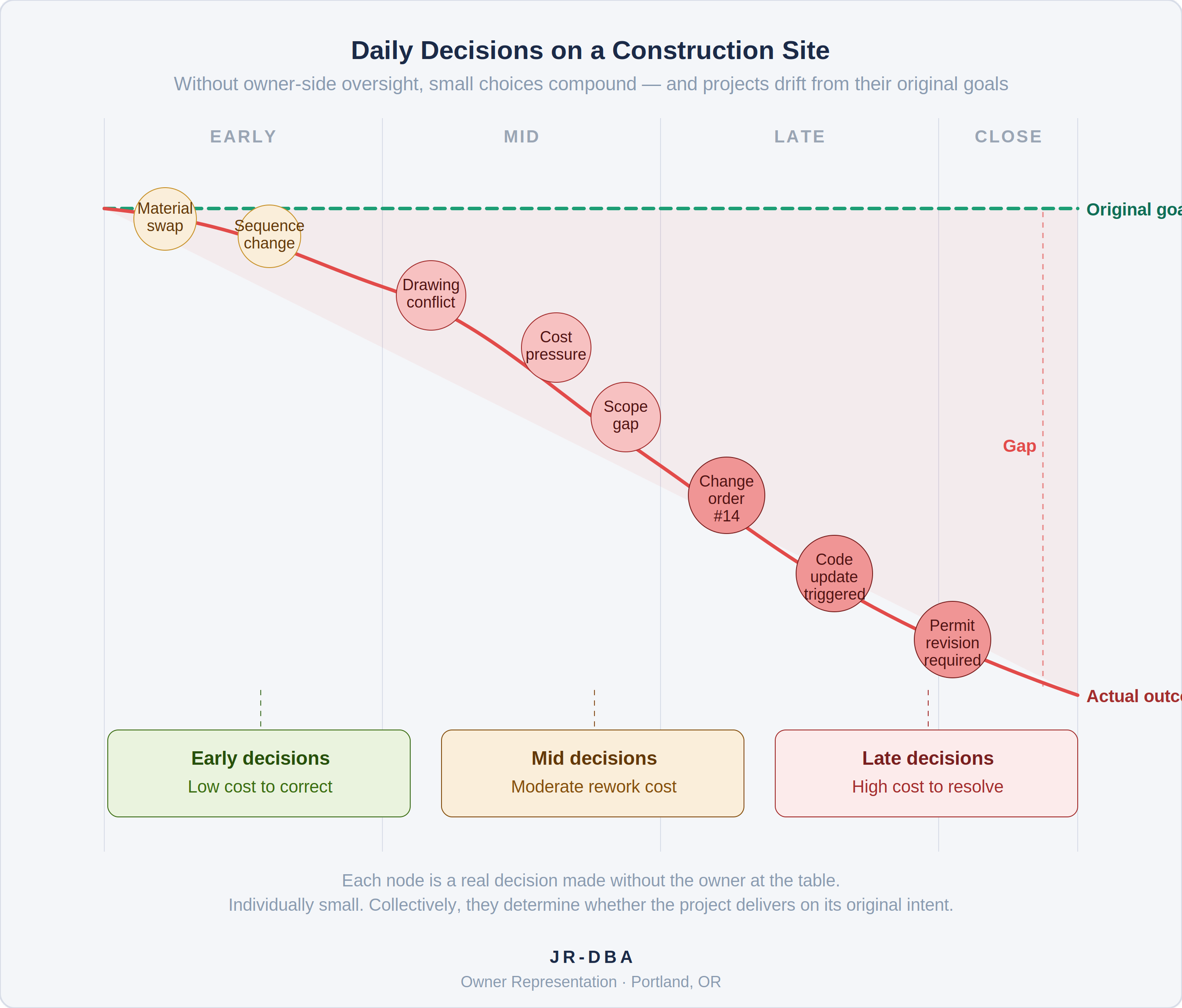
Construction costs often escalate when key scope, permitting, or coordination decisions are delayed. Early planning reduces downstream change orders and project risk.
Experienced project oversight helps identify coordination gaps before they become change orders.
The Biggest Misunderstanding: Who Is Protecting the Owner?
Many owners assume that everyone on the project team is looking out for their interests. That assumption is understandable — and largely unfair to the professionals involved, most of whom are genuinely trying to deliver a great project.
But responsibilities and incentives differ for every participant. Understanding those differences is not about distrust — it is about knowing who is accountable for what.
The Architect
Architects are essential to successful projects. They bring design expertise, technical knowledge, permitting coordination, and creative vision that no other team member can replace. Many architects genuinely advocate for owners throughout the project.
However, their primary responsibility centers on design, documentation, permitting, and implementation of the project drawings — not on acting as the owner's financial advocate or risk manager. An architect's scope typically does not include contractor negotiations, bid leveling, aggressive cost protection, or independent contractor oversight.
That is not a criticism. It is simply a role distinction worth understanding.
The Contractor
A good contractor is invaluable. They coordinate trades, manage labor and materials, sequence the work, and ultimately build the project. Their expertise in means and methods is irreplaceable.
But contractors also operate businesses. Their incentives naturally include managing profitability, limiting risk exposure, protecting schedule commitments, and managing material and labor uncertainty. None of that makes them adversarial — it simply means their priorities are not identical to the owner's priorities.
The Owner's Representative
The owner's representative exists for one primary reason: to keep the project aligned with the owner's goals.
They act as a translator between technical professionals and owner priorities — helping owners understand tradeoffs before those tradeoffs become expensive, advocating for the owner's interests in every conversation, and maintaining clear-eyed perspective on cost, schedule, quality, and risk throughout design and construction.
The owner's representative serves as the bridge between the owner's goals and the technical realities of design and construction.
Not every project requires dedicated owner representation. But projects involving greater complexity, higher stakes, or unfamiliar process often benefit significantly from additional owner-side advocacy.
Residential Projects
For high-expectation residential projects, owner representation helps navigate the hundreds of decisions, competing priorities, and evolving scope that characterize major remodels and custom homes. Without careful coordination, homeowners often find themselves making consequential technical decisions they were never prepared to make — often under time or cost pressure.
Owner-side representation can add meaningful value on:
Major remodels and whole-home transformations
Custom homes with complex programs or site conditions
Projects involving multiple consultants or contractors
Historic homes or complex existing conditions
Projects where quality expectations are especially high
Commercial Projects
Commercial projects introduce additional layers of complexity — permitting requirements, accessibility obligations, occupancy classifications, change-of-use triggers, and phasing constraints that can significantly affect cost and schedule. Early planning and experienced oversight often reduce risk and improve outcomes.
Construction Manager as Advisor role adds particular value on:
Tenant improvements (TIs) and office conversions
Owner-user commercial spaces and retail
Churches and assembly occupancies
Multi-contractor coordination or owner-direct subcontractor models
Projects involving accessibility upgrades, permitting complexity, or significant building code considerations
Complex permitting environments
Phased or occupied construction
Commercial tenant improvements involve permitting, accessibility, and occupancy requirements that can materially affect project cost and timeline.
Why Code and Permitting Expertise Matters More Than Most Owners Expect
One of the most overlooked cost drivers in construction is code compliance and permitting. Many owners underestimate how significantly building code requirements can affect project scope, cost, and timeline — especially when projects involve change of use, additions, or work in older buildings.
Depending on the project, issues may include:
• Accessibility upgrades triggered by scope or valuation thresholds
• Occupancy classification changes that affect life safety requirements
• Change-of-use triggers requiring structural or egress upgrades
• Energy code impacts on mechanical, electrical, and envelope systems
• Existing building provisions and historic structure considerations
• Fire and life safety requirements for assembly or high-occupancy spaces
• Seismic or structural upgrade requirements
These issues are rarely intentional oversights. They emerge as projects become more defined. But discovering them late — during design development, permit review, or active construction — can be expensive.
Early feasibility, code awareness, and permitting strategy help owners make informed decisions before redesign, delays, or change orders force the issue.
For a deeper look at the hidden cost drivers that affect residential and commercial projects, see our Hidden Cost Drivers White Paper.
Permitting and code compliance are among the most commonly underestimated cost drivers in construction projects.
How JR-DBA Supports Owners During Design and Construction
At JR-DBA, owner representation and Construction Manager Advisor (CMa) services are built around a single goal: helping owners make informed decisions while protecting project intent from early planning through construction completion.
Our background spans residential architecture, commercial design, permitting, and construction management — which means we understand the technical realities on both sides of the table. We know how design decisions affect constructability, how permitting assumptions affect schedule, and how contractor proposals should be evaluated before they become contracts.
That experience informs everything we do on behalf of owners.
Owner representation and CMa services at JR-DBA may include:
• Early feasibility and project risk identification
• Design and consultant coordination
• Permitting strategy and code awareness
• Budget and scope alignment throughout design
• Contractor proposal review and bid leveling
• Construction oversight and owner advocacy
• Change order review and negotiation support
• Decision support during high-pressure moments in construction
Whether the project is a high-end residential remodel, a custom home, a tenant improvement, an office conversion, or an owner-user commercial space — thoughtful planning and owner-side advocacy can reduce risk, reduce surprises, and improve outcomes.
Learn more about Owner's Representation and CMa services at JR-DBA.
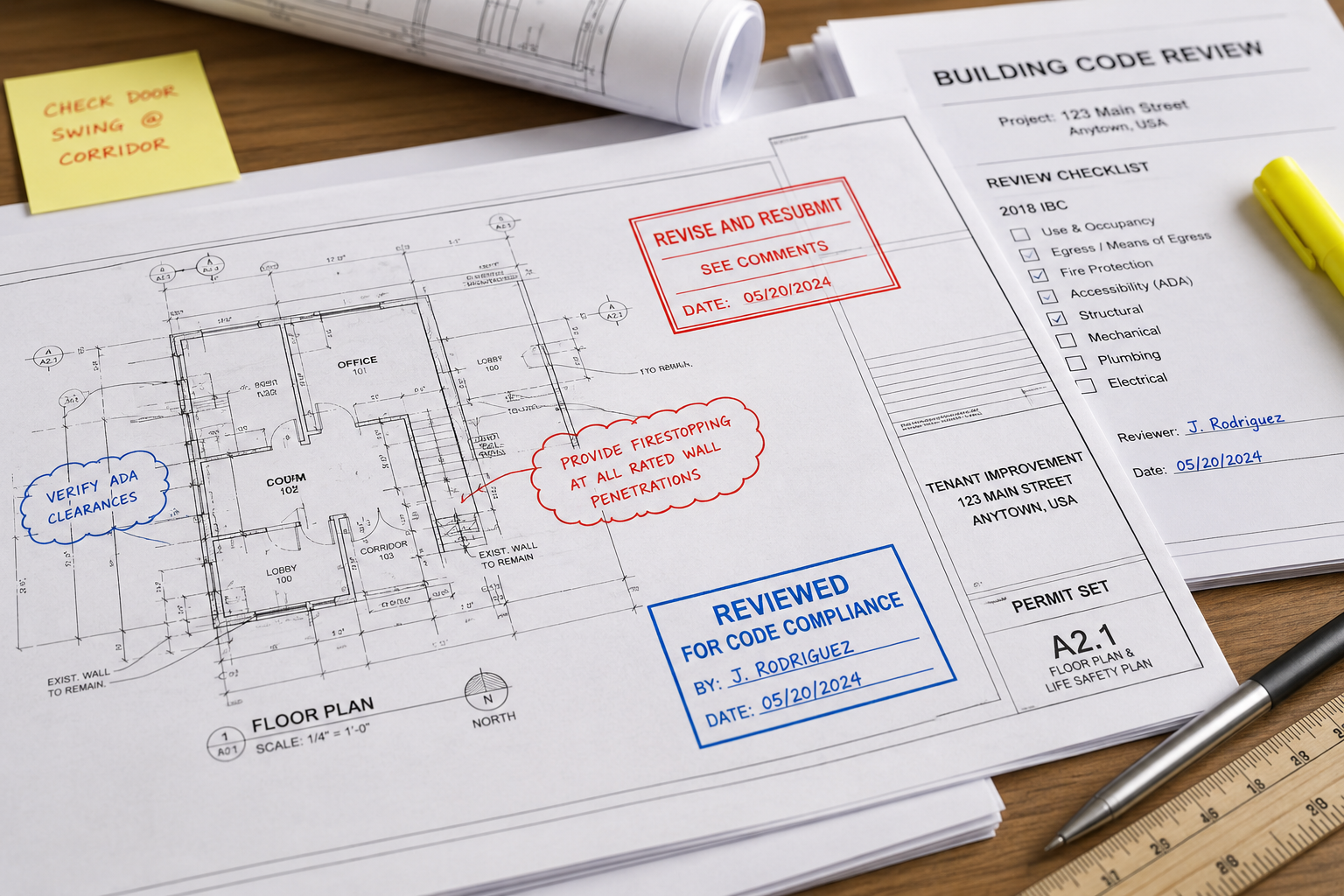
Early permit and code review can identify hidden risks before construction begins, reducing redesigns, delays, and costly changes.
JR-DBA brings architectural and construction management expertise to owner representation — helping clients navigate design and construction with confidence.
Planning a Project? Start with a Feasibility Conversation.
The best time to identify project risks is before design begins. The second best time is right now.
If you are planning a major remodel, custom home, tenant improvement, or commercial renovation — and you want someone in your corner who is specifically accountable to your interests — we would be glad to talk.
Our commitment to you. Your information is yours. We will NEVER sell your information.
