
Portland ADU Zoning, Setbacks & Size Requirements Explained
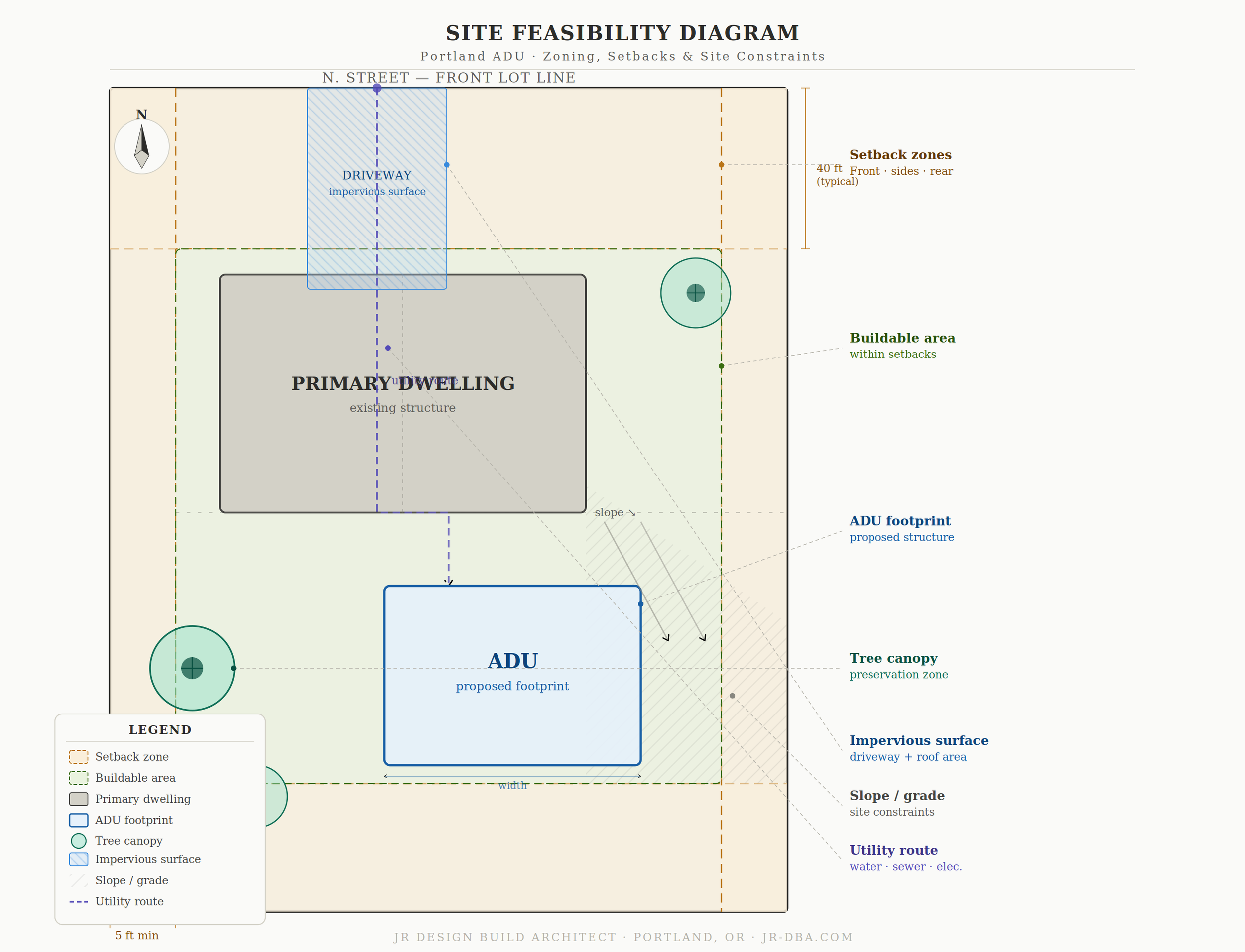
Portland ADU feasibility depends on more than backyard space. Zoning, setbacks, utilities, impervious surface, trees, and site constraints all influence what may be possible on a property.
Many homeowners begin exploring an Accessory Dwelling Unit (ADU) with a simple question: "What are the rules for building an ADU in Portland?"
At first glance, the answer may appear straightforward. However, many homeowners quickly discover that ADU feasibility depends on far more than having enough backyard space.
Zoning, setbacks, height limits, utilities, trees, site conditions, stormwater impacts, and property configuration can all affect what is realistically possible.
The better question is often not simply "Can I build an ADU?" — but rather: "What zoning and site limitations may affect what I can build on my property?"
Want more information? Check out article:
"Can I build an ADU on my property in Portland?"
Understanding these constraints early can help homeowners avoid costly redesign, permitting delays, and unexpected surprises.
Many Portland Properties Can Support an ADU
Portland has broadly encouraged ADU development for years, and many residential properties across the city may qualify. That said, every property is different — and a neighbor's ADU does not mean the same approach will work on yours. Even adjacent lots can have very different constraints.
Under current Portland zoning code, up to two ADUs may be allowed on a lot that already has a house, attached house, or manufactured home — provided the site meets minimum lot size requirements and fronts a city-maintained street. The exact allowances depend on your specific zone.
Make sure you don’t get caught off guard with hidden costs: Check out
“Why ADUs in Portland cost more than expected”
Key size limit: Detached ADUs are generally limited to 75% of the primary dwelling's living area, or 800 sq ft — whichever is less. On lots larger than 5,000 sq ft, this may increase to 1,000 sq ft. Always verify with your specific zone.
What Zoning Rules Affect ADUs in Portland?
ADUs are permitted across many Portland residential zones — including R2.5, R5, R7, R10, and R20 — but your zone still determines key parameters, including where an ADU can be placed, how large it can be, and what design standards apply.
Where the ADU can be located
In many cases, detached ADUs are required to be located behind the primary dwelling or meet minimum front setback placement standards — 40 feet in many cases. Exact placement depends on zoning, lot configuration, and site conditions. The shape of the lot, existing structures, and setback limitations often determine where an ADU may realistically fit.
How large it can be
Maximum size is determined by the primary dwelling's footprint and lot size, not simply by available yard space. Practical layout efficiency, utility placement, and open space often influence design just as much as raw square footage.
Building height
Portland's height rules for ADUs depend on where the structure is located relative to setbacks:
Outside required setbacks: maximum height of 20 feet
Inside required setbacks: maximum height of 15 feet, with exterior wall height capped at 10 feet
Detached ADUs cannot exceed the height of the primary dwelling
Height restrictions affect roof shape, ceiling heights, loft spaces, and second-story layouts. This is one reason feasibility review often matters before significant design begins.
Understanding Setback Requirements
Setbacks determine how close a structure may be located to property lines — and are one of the most important factors affecting detached ADU placement.
Portland's minimum side and rear setbacks for ADUs start at 5 feet — though this can vary by zone, roof type, and design. Some configurations, such as shed roofs or covered landings, may require larger setbacks.
Rear yard setbacks
Often the primary consideration for backyard ADUs, and one of the most commonly underestimated constraints during early planning.
Side yard setbacks
These influence usable building width and overall layout — particularly on narrower lots.
Front setback
In many cases, detached ADUs are required to be located behind the primary dwelling or meet minimum front setback placement standards — 40 feet in many cases. Exact placement depends on zoning, lot configuration, and site conditions. This can eliminate placement options that homeowners initially assume are viable.
Property types where setbacks create the most complexity
Narrow lots
Flag lots
Corner lots
Irregularly shaped properties
What type of ADU makes the most sense for your property? Try reading: "Detached ADU vs. garage conversion in Portland"
Parking Considerations
Many homeowners assume building an ADU automatically requires additional parking. Depending on project type and location, parking requirements may differ from what owners expect.
Existing driveway conditions, access limitations, and site layout can still affect overall project feasibility — even when no additional parking spaces are formally required. These are worth evaluating early in the planning process.
Site Constraints That Often Affect ADU Feasibility
Zoning compliance alone does not guarantee a straightforward project. Many Portland properties encounter additional site-specific constraints that shape — or limit — what is possible.
Trees
Tree preservation requirements can significantly affect ADU placement, excavation limits, utility trenching, and site layout. On some properties, trees become one of the largest design drivers.
Impervious surface and stormwater
New development may increase roof area, walkways, patios, and paved surfaces. In Portland, stormwater management requirements apply when a project creates 500 square feet or more of new impervious surface — and rainwater must generally be managed on-site for both attached and detached ADUs.
This is one of the most commonly overlooked issues during early ADU planning.
Slope and topography
Steep sites may require retaining walls, grading, drainage systems, or specialized foundations. Even modest slope can affect construction cost — often more than homeowners anticipate.
Utilities
Water, sewer, and electrical access are frequently underestimated. Utility routing may influence ADU location, construction cost, and permit complexity. Some sites require separate sewer connections or larger water lines depending on fixture counts and site conditions.
Overlay zones and special districts
Some properties carry additional considerations — environmental overlays, floodplain designations, historic review requirements, or design review criteria — that can meaningfully affect project feasibility. Historic designations in particular may require Community Design Standards review.
Detached vs. Attached vs. Garage Conversion ADUs
The type of ADU also shapes what to expect from the process.
Detached ADUs
Often provide better privacy, greater design flexibility, and a more independent living feel — but may involve more site work, utility trenching, and stormwater considerations.
Attached ADUs
These integrate with the existing home and may simplify some aspects of construction, but can introduce structural and layout challenges of their own.
Garage conversion ADUs
Can sometimes reduce exterior construction costs, but frequently uncover hidden conditions within the existing structure. No single approach works best for every property.
For permitting information look at our article:
"How long does it take to permit an ADU in Portland?"
Why Early Feasibility Review Matters
One of the most common mistakes homeowners make is assuming that if zoning allows an ADU, the project should be straightforward. In reality, zoning is only one piece of the puzzle.
Many ADU challenges arise from site constraints, utility conditions, existing structures, tree preservation requirements, stormwater impacts, and budget realities that only become visible once a property is studied in detail.
"Understanding these issues early often reduces redesign and helps homeowners make more informed decisions before significant money is spent on plans."
Many Portland properties can support an ADU — but zoning, setbacks, height limitations, site conditions, and utility considerations all influence what is realistically achievable.
A successful project often begins with understanding the property before design starts — not after permit comments arrive.
Closing Thoughts
Every property is different, and successful ADU projects often begin with understanding zoning, site constraints, utilities, permitting requirements, and realistic project costs before significant money is spent on plans. Whether you are exploring an ADU for rental income, family housing, or long-term flexibility, early planning can help reduce surprises and improve project predictability. Learn more about JR DBA’s Residential Architectural Services, Owner’s Representation Services, or request an Early Feasibility Review to better understand what may be possible for your property.
