
Why Old Timber Buildings Last: Lessons in Joinery and Movement
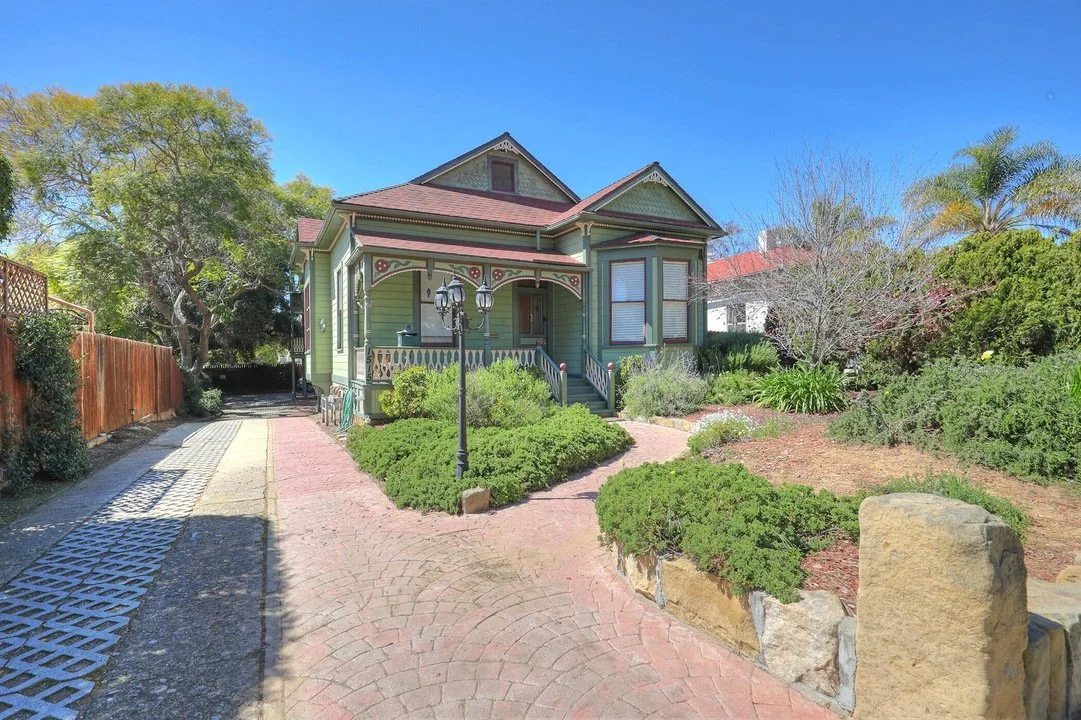
Historic Victorian home restoration project demonstrating how thoughtful design, preservation of original architectural character, and strategic site improvements can extend the life and value of an existing residence.
Walk through a century-old timber-framed building and you'll often find something remarkable: the structure is still performing largely as intended. The floors may slope slightly, and the wood bears the marks of generations of use — but the building remains standing, functional, and surprisingly resilient. In many cases, these structures have outlasted multiple generations of newer construction.
The reason is not simply that old-growth lumber was stronger or that builders "made things better back then." The reality is more nuanced. Many historic timber structures survive because they were designed around a fundamental truth that still governs wood construction today: wood moves.
The craftsmen who built these structures understood that reality and designed their connections, assemblies, and details accordingly. As architects and building professionals, there is still a great deal we can learn from that approach.
Wood is not a static material
Unlike steel or concrete, wood continues to respond to its environment long after it has been milled and installed. Changes in temperature and — more critically — moisture content cause wood to expand and contract over time. The American Wood Council has long emphasized that dimensional change is an inherent characteristic of wood products: movement occurs across the grain far more than along the length of a member, and while it is predictable, it cannot be eliminated.
Historic builders understood this intuitively. Rather than attempting to completely restrain wood movement, they designed assemblies that could accommodate it. Their goal was not to prevent movement — it was to allow movement without creating damage. That distinction matters.
The genius of traditional joinery
Many historic timber structures relied on mortise-and-tenon connections, wooden pegs, dovetails, and other forms of traditional joinery. At first glance, these connections appear primitive compared to modern metal connectors and engineered fastening systems. In reality, they were highly sophisticated responses to the behavior of wood. Traditional joinery distributed loads over larger contact areas, allowed small amounts of relative movement without triggering failure, and could often be repaired rather than replaced. Rather than forcing a rigid connection, the assembly worked with the material.
This principle is still visible in surviving timber barns, historic churches, Craftsman bungalows, and heavy timber commercial buildings throughout the Pacific Northwest.
When a historic structure is part of a renovation or addition project, understanding original framing logic is the first step. JR-Design Build Architect provides architectural services for residential and commercial projects across the Portland metro area — including code analysis, existing conditions documentation, and construction documents that respect how a building was designed to perform.
Learn about our architectural services →
When buildings fight their materials
A lesson repeated throughout building science literature is that failures most often occur where assemblies attempt to resist natural material behavior. Wood shrinks and swells. Buildings settle. Materials expand and contract at different rates. When an assembly does not accommodate these realities, stress accumulates — and over time that stress manifests as cracked finishes, split framing members, separation at joints, distorted openings, and new pathways for water intrusion.
Many modern construction systems perform exceptionally well when detailed correctly. But the underlying principle remains unchanged: successful buildings acknowledge movement rather than pretending it does not exist. The Journal of Light Construction continues to highlight moisture management, shrinkage, and differential movement as the primary drivers of long-term building performance — regardless of construction era.
"Durable buildings work with their materials rather than against them."
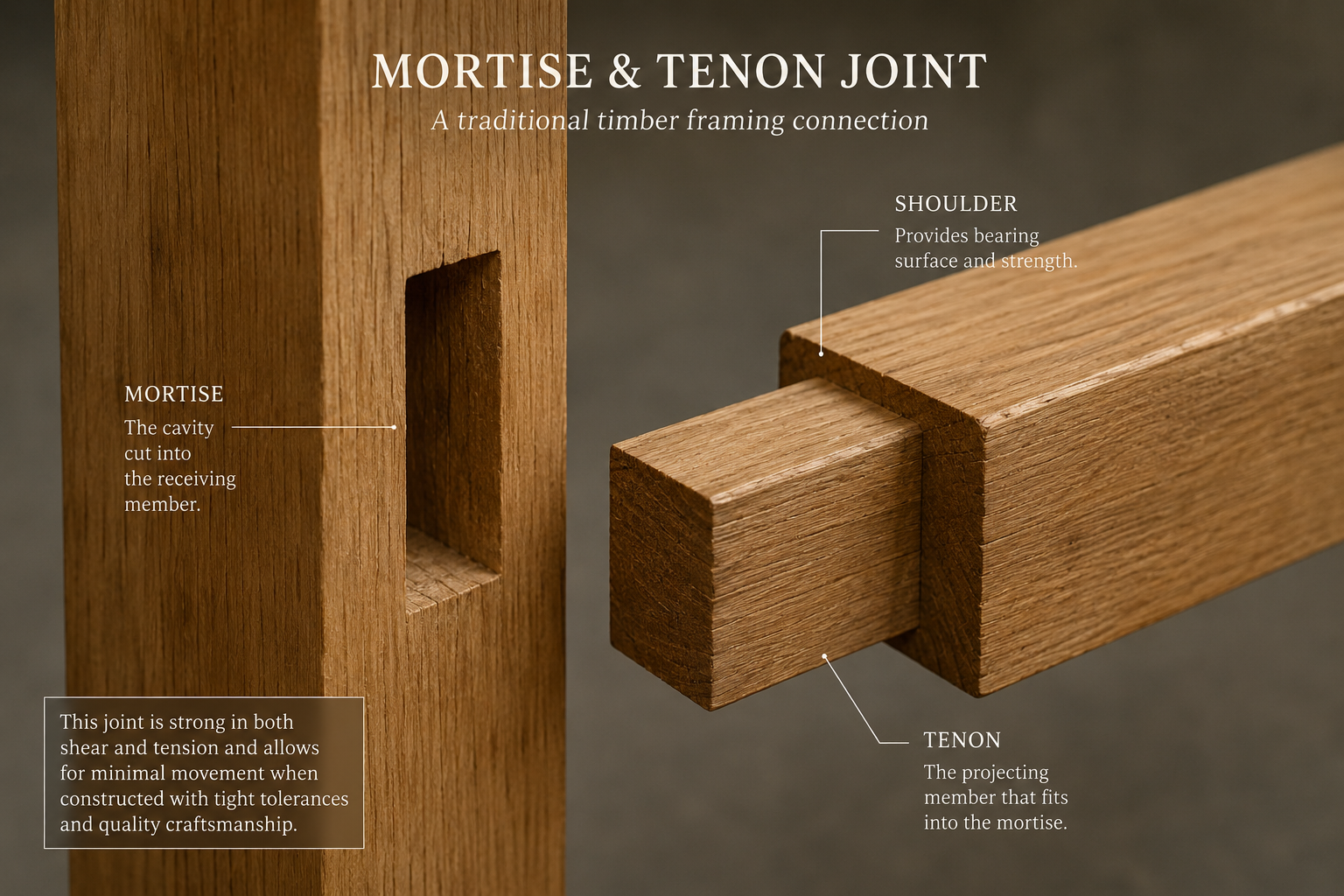
Mortise-and-tenon joinery has been used for centuries in timber construction, allowing wood structures to transfer loads efficiently while accommodating natural material movement.
Why heavy timber ages gracefully
Large timber elements behave differently than smaller dimensional lumber. Heavy members dry more slowly, char predictably during fire exposure, and tolerate localized defects in ways that engineered wood products often cannot. Many historic structures also incorporated structural redundancy — loads distributed through multiple framing members rather than relying on a single highly optimized component. This approach was not always efficient by modern standards, but it proved remarkably durable. The result is a building that can absorb change, accommodate movement, and continue functioning even as individual elements age.
Lessons for modern remodels
These principles become particularly important when working on older Portland homes. Many structures built during the Craftsman era contain details that intentionally accommodate movement — details that can be disrupted by well-intentioned but poorly sequenced modern renovations.
Common problems arise when remodels trap moisture within assemblies that were designed to dry, remove structural elements without fully understanding original load paths, introduce rigid finishes into areas where movement previously occurred freely, or connect new framing to old framing without accounting for differential movement over time. A successful remodel begins with understanding how the original building was intended to perform — and why it has survived this long in the first place.
Renovation projects on older buildings carry risks that standard contractor oversight may not catch. JR-Design Build Architect provides owner's representation and Construction Manager as Advisor (CMa) services to keep project intent intact through design and construction — from evaluating contractor bids to tracking RFIs and monitoring work in the field.
Learn about owner's representation services →
The bigger lesson
The buildings that endure are rarely the ones that attempt to overpower nature. They are the ones that acknowledge it. Historic craftsmen understood that wood would move, moisture would find pathways, and buildings would change over time. Rather than treating those realities as defects, they incorporated them into the design.
That philosophy remains just as relevant today — whether designing a custom home, renovating a century-old Craftsman, or evaluating an existing structure before a major remodel. The tools may have changed, and the materials have evolved, but the principle that made historic timber buildings successful has not.
Respect the material. Allow for movement. Build for the long term.
JR-Design Build Architect | Portland, Oregon
Architectural Design · Owner's Representation · Construction Management Advisory
