
The 3 Biggest Risks That Cause Remodel Cost Overruns
Why "simple" projects spiral—and how to prevent it
Introduction
Most remodel projects don't start out over budget.
They begin with a clear scope, a reasonable budget, and a defined goal. But somewhere between design, permitting, and construction, costs begin to climb — and often don't stop. The frustrating part is that these overruns are rarely random. They follow a predictable pattern, driven by the same three gaps that derail projects again and again.
In our white paper, "The Hidden Cost Drivers in Portland Residential Construction," we outline how gaps in scope, code, and coordination lead to cost escalation across residential projects in the Portland metro area. This article focuses on the three most common risks that drive those overruns — and what you can do to get ahead of each one.
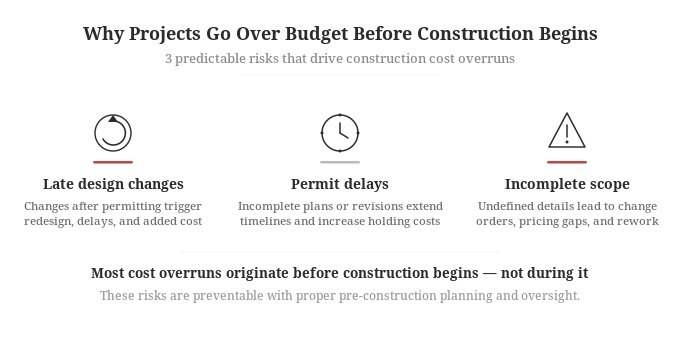
Common triggers for over budget projects
Risk #1: Incomplete or Underdeveloped Scope
This is the most common cause of cost overruns, and it's the one that tends to catch homeowners most off guard — because at the start of a project, the scope feels defined. There's a plan, a budget range, and a general idea of what's getting built. What's often missing is verified information about existing conditions.
Many remodels begin with concept-level plans, assumptions about what's inside the walls, and limited coordination between structural, mechanical, electrical, and plumbing systems. That's workable during design. It becomes expensive during construction, when those assumptions collide with reality: a beam that isn't where the drawings assumed it was, a plumbing stack that runs through the middle of the proposed kitchen layout, electrical that hasn't been touched since the 1960s.
Each of these conditions triggers the same sequence — design revision, field decision, change order — and each one costs more to resolve mid-construction than it would have during the planning phase. The discipline that prevents this is investing in scope definition before anyone starts swinging a hammer. A conditions assessment, even a basic one, gives you real information to price against rather than assumptions to hope against.
If the scope is not fully resolved before construction,
it will be resolved during construction — at a higher cost.
Risk #2: Code and Permit Gaps
Permitting is not a formality. It's the point in a project where your plans are tested against actual code requirements — and where the scope of a "simple remodel" can quietly expand.
Common permit-phase surprises include missing or incomplete drawings that trigger correction comments and re-submittals, energy compliance requirements that pull in insulation or mechanical upgrades on older homes, structural reviews that surface seismic or load concerns, and scope that was designed without reference to current code. Any one of these can add weeks to a timeline and thousands to a budget. In combination, they can fundamentally reshape a project.
The local permitting landscape matters enormously here. The City of Portland, the cities within Washington County — Beaverton, Hillsboro, Tigard — and unincorporated Washington County each have their own jurisdictions, processes, and review timelines. What applies to one doesn't necessarily apply to another, and submitting to the wrong jurisdiction wastes time before anyone catches it.
We've written about these local permitting dynamics in depth in two companion posts: [The 3 Biggest Risks That Cause Remodel Cost Overruns in Portland] covers what's specific to Portland — including the city's seismic triggers, energy code requirements, and the current state of the permit review process. [The 3 Biggest Risks That Cause Remodel Cost Overruns in Washington County] covers what homeowners in Beaverton, Hillsboro, Tigard, and unincorporated Washington County need to know, including the jurisdictional distinction that surprises many first-time applicants.
Permitting doesn't just approve your project — it has the power to reshape it.
Getting ahead of permit risk means engaging with code requirements during design, not after submittal. An architect or design professional who knows the local permitting landscape can identify potential scope expansions before they become surprises.
Risk #3: Disconnect Between Design and Construction
Even on projects with solid scope and clean permits, costs can escalate during construction — when there's a gap between what was drawn, what was intended, and what actually gets built.
This happens more often than it should, and it's usually not a failure of effort. It's a failure of communication and detail. A drawing set that looks complete in the office may not account for real-world field conditions: irregular framing, non-standard dimensions, pipes or ducts in unexpected locations. When drawings leave those conditions unresolved, field decisions get made by whoever is on site — quickly, under pressure, without the full context of the design intent.
The specific failure modes are familiar to anyone who has managed construction: unclear details that one trade interprets differently than another, assemblies that are difficult to build as designed, and mechanical, electrical, and plumbing work that wasn't coordinated so each trade's rough-in conflicts with the next. The result is rework, delays, and added labor costs — often compounding the schedule and budget pressure that already exists from earlier-stage issues.
This is where owner's representation makes a concrete difference. Having someone whose job is to verify that assemblies are being built correctly, catch discrepancies before they're covered up by the next phase of work, and provide a clear point of accountability when field conditions require real-time decisions — that's not overhead. On a complex remodel, it's the most reliable way to protect what you spent on design from being undermined in the field.
Without alignment between design and construction, cost overruns are almost inevitable.
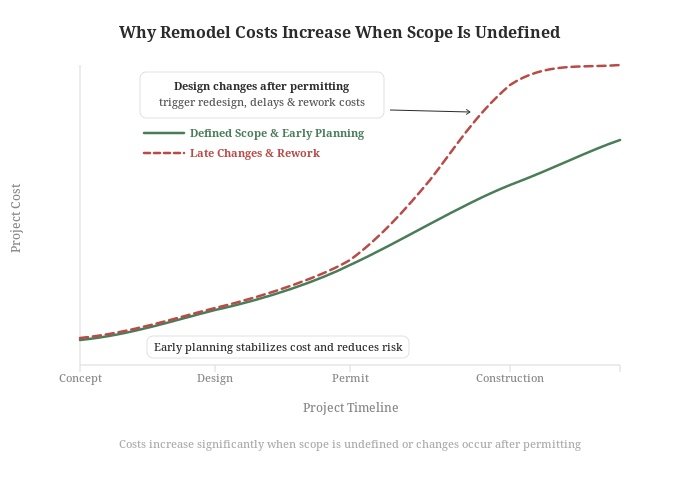
Remodel Cost Escalation Curve
Why These Risks Compound
These risks don't usually show up in isolation. They stack — and each one makes the next one worse.
A typical sequence: scope is incomplete at the start, so permit drawings are underdeveloped. Permit review identifies gaps, requiring redesign. Construction begins with less time cushion than planned and coordination questions still unresolved. Field conditions trigger additional changes. The original budget, which was already tight, is now underwater.
Each step adds cost, time, and complexity. The cascade is predictable. So is the prevention.
How to Prevent Cost Overruns
Avoiding cost overruns is not about eliminating change — change is part of construction. It's about controlling when change happens. Changes made during design cost relatively little. Changes made after permit approval cost more. Changes made during construction cost the most.
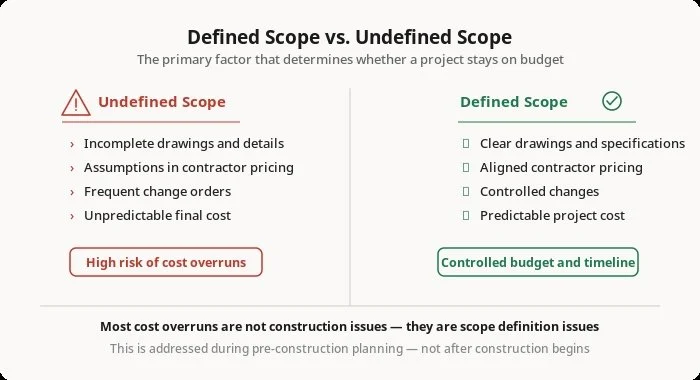
Defined vs Undefined Project Scope
The strategies that work consistently:
Fully define the project before pricing — scope based on verified conditions, not assumptions
Identify code and permit requirements during design, not after submittal
Ensure drawings are detailed enough to be built without field guesswork
Build in construction oversight to catch issues while they're still correctable
Early involvement of an architect or owner's representative helps bridge the gap between design intent and construction reality — reducing risk before it has a chance to turn into cost.
Conclusion
Remodel cost overruns are not inevitable. They're driven by incomplete scope, permitting gaps, and misalignment between design and construction — and each of these can be identified and addressed before they cost anything significant.
For homeowners planning a remodel in Portland, see our Portland-specific post for what's particular to the city's housing stock, seismic requirements, and permitting process. For homeowners in Washington County, see our Washington County post for the jurisdictional landscape and what local permitting looks like in Beaverton, Hillsboro, Tigard, and beyond.
For a deeper breakdown of how these cost drivers develop and what they typically look like across the Portland metro area, see our white paper: "The Hidden Cost Drivers in Portland Residential Construction."
