
Washington County Construction Costs: Why Projects in Beaverton and Hillsboro Run Over Budget
Why projects in Beaverton, Hillsboro, Tualatin, and surrounding westside cities — including ADUs, remodels, and new construction — carry different and often underestimated cost risk than Portland proper
Risk #1: Permitting Path Misclassification
The westside does not have one permit system — it has many
In Portland, most owners and contractors are familiar with the Bureau of Development Services and its general processes. On the westside, there is no equivalent single authority.
Washington County handles unincorporated land. Beaverton, Hillsboro, Tualatin, Tigard, Sherwood, and Forest Grove each operate their own planning and building departments, with their own procedures, fee schedules, application types, and review timelines.
The cost risk begins when a project is classified under the wrong permitting path. In Washington County and the surrounding westside cities, the difference between a ministerial permit and discretionary review can materially affect both budget and schedule. What appears to be a straightforward residential remodel, addition, ADU, or light-commercial improvement can shift from a simple permit review into a multi-month entitlement process.
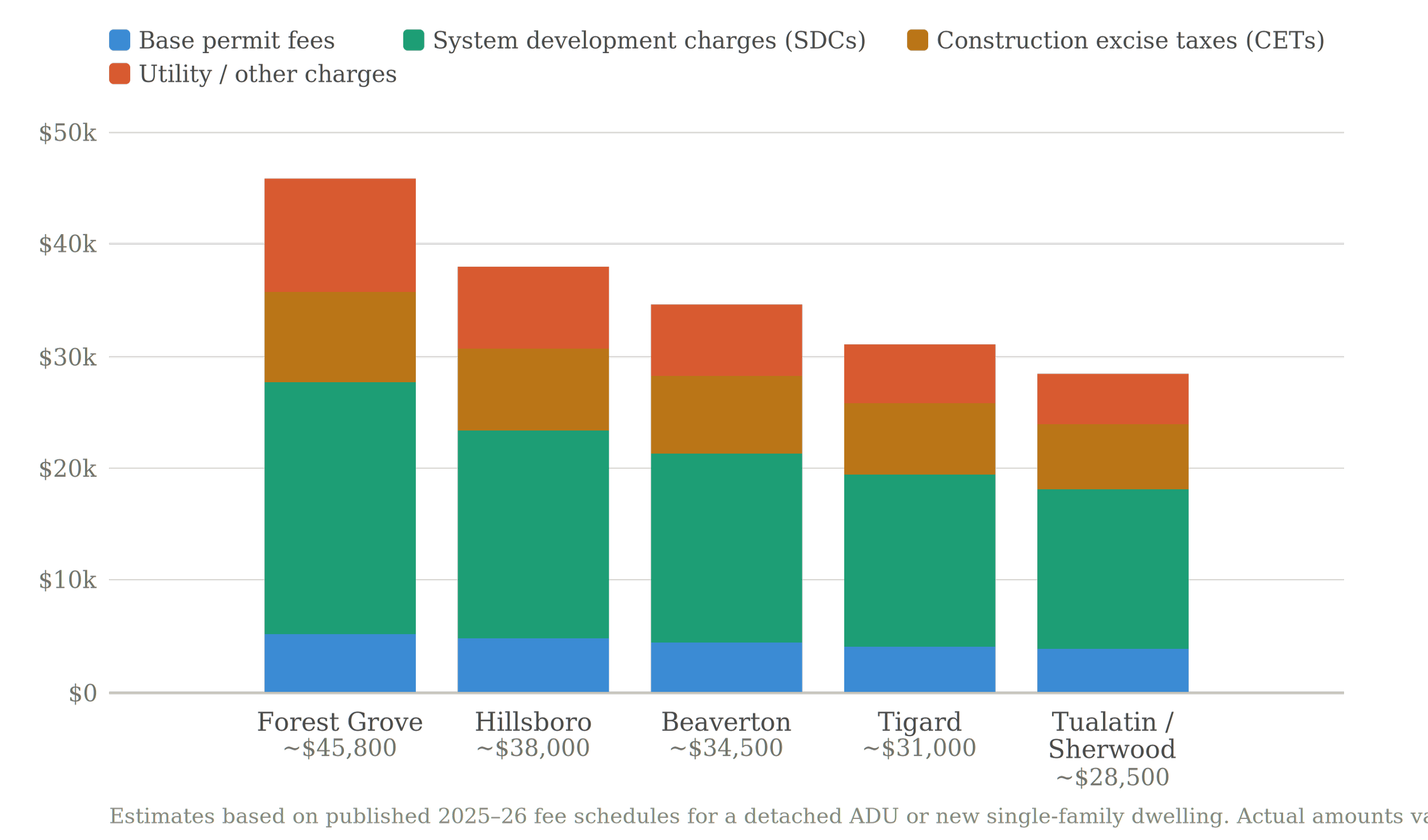
Permit and development-related costs vary significantly across Washington County jurisdictions. In many cases, system development charges (SDCs), utility requirements, and local excise taxes can exceed base permit fees and materially affect project feasibility.
In this region, that difference is often the difference between a few weeks and several months — and between a modest soft-cost allowance and $25,000 to $75,000 or more in added design, civil, legal, and consulting work.
ADU permitting on the westside: a common misclassification point
Accessory dwelling units are one of the most frequently misclassified project types in this region.
Oregon’s ADU-friendly statewide legislation has made it easier to permit detached and attached ADUs in many jurisdictions. However, westside cities have implemented those rules differently, and the local details can significantly affect cost, timeline, and design feasibility.
An ADU design that qualifies for ministerial review in one city may trigger design review, owner-occupancy verification, tree assessment, utility coordination, or a Clean Water Services prescreen in an adjacent jurisdiction. Detached ADUs with separate utility connections may also require additional engineering, meter coordination, and System Development Charge review that does not appear in early project budgets.
Unlike Portland, where ADU permitting pathways are well-established and widely understood by many local design teams, the westside’s multi-city structure means that experience in Beaverton does not automatically transfer to Hillsboro, Tualatin, Tigard, Sherwood, Forest Grove, or unincorporated Washington County.
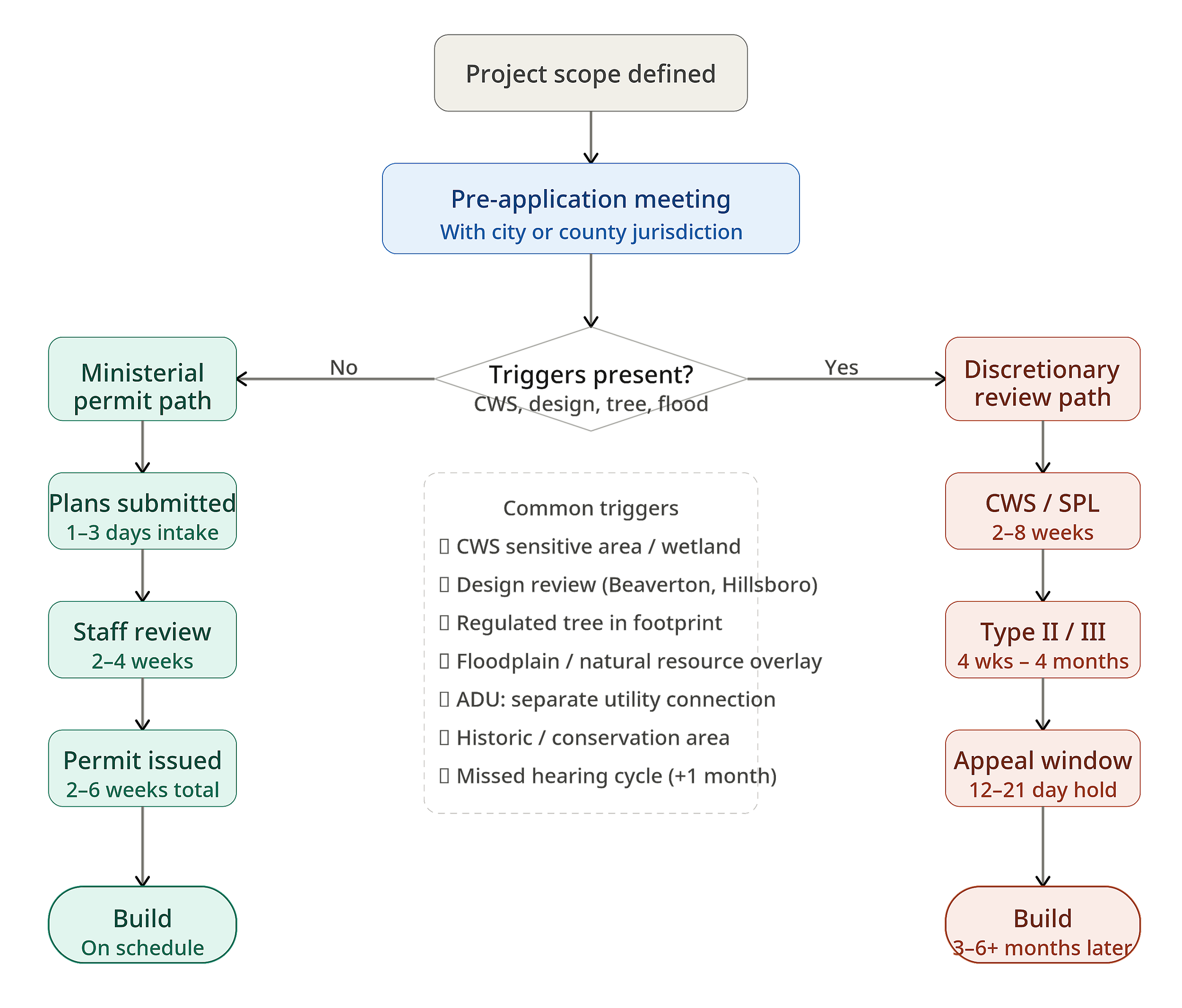
Residential permitting in Washington County often involves multiple parallel review paths, including jurisdictional permit review, utility coordination, storm-water review, and service-provider requirements. Early due diligence helps avoid delays and unexpected redesign costs.
Working with an experienced residential architect familiar with westside ADU permitting — including utility coordination, setback variations, tree code implications, and city-specific review triggers — is one of the most reliable ways to avoid costly misclassification early in the process.
What else can trigger a longer permitting path?
Beyond ADUs, every westside jurisdiction has its own set of review triggers. Some of the most common sources of permitting path escalation include:
Design review — required in Beaverton for certain scales and types of development, including downtown design review and Facilities Review Committee sign-off.
Historic and conservation review — active in Beaverton, Tualatin, and Hillsboro for properties in designated areas.
Tree permits and arborist reports — commonly required when regulated trees are located within the project footprint or disturbance zone.
Floodplain and natural resource permits — Hillsboro’s Regulatory Floodplain Overlay and Significant Natural Resource Overlay create distinct permit tracks.
Washington County Type III hearings — heard on the third Thursday of most months, meaning a missed cycle can add roughly a calendar month before redesign time is even counted.
Appeal windows — Type I and Type II decisions can be appealed within 12 calendar days in Washington County; hearings-officer decisions can proceed to the Land Use Board of Appeals within 21 days.
Hillsboro’s published review structure illustrates the scale of variation. A Type I application may be resolved in one to three days or one to two weeks, while a Type II application may take roughly four to six weeks, and a Type III application can run three to four months.
Crossing from one review lane to another — often because an overlay was missed, a site constraint was misunderstood, or an application type was misclassified — can restructure the entire project schedule.
The most reliable early investment is a pre-application meeting with the jurisdiction. This is often the least expensive way to determine whether your project is a straightforward building permit or a multi-month entitlement process before you commit to a budget, GMP, or construction start date.
What this costs
The direct application fees are rarely the largest impact. The real financial impact comes from added rounds of design, consultant coordination, carrying costs during review, and contractor repricing if the permit timeline slips.
For residential entitlements with discretionary triggers, budgeting a soft-cost risk allowance of roughly $10,000 to $30,000 is prudent. For small multifamily or light-commercial discretionary review paths, $25,000 to $75,000 or more is a more realistic floor.
Risk #2: Site, Environmental, and Civil Surprises
Clean Water Services changes what “infill” means
In Portland, most residential remodel and ADU clients are thinking primarily about the existing structure, building systems, and finishes. On the westside, the site itself is often where the largest hard-cost swings originate.
That is because the entire Washington County area sits within the Clean Water Services service territory, and Clean Water Services review is a central permit gate for many projects involving site disturbance.
On the westside, site conditions can matter as much as the building itself. Clean Water Services review can reshape what appears to be a straightforward remodel, room addition, detached ADU, backyard cottage, or small infill project.
Clean Water Services requires environmental review for developer projects before city permit coordination proceeds. If no sensitive area appears on or within 200 feet of the site, a prescreen may be sufficient. If a sensitive area is present, a site certification or standard site assessment may be required before a Service Provider Letter can be issued.
That Service Provider Letter is often a prerequisite for the local building permit.
The stacking problem
The most expensive pattern on westside sites is not usually one single environmental finding. It is the sequence of approvals that must be resolved before the building permit can move forward.
That sequence may include:
Clean Water Services prescreen, followed by a Service Provider Letter or site certification.
Local land-use review for exterior changes, added site coverage, or increased impervious area.
Engineering or public-works sign-off for site disturbance, grading, drainage, utilities, or frontage work.
Erosion-control permits triggered by disturbance area thresholds.
DEQ 1200-CN permit coverage for disturbance between one and five acres, or a 1200-C permit for five acres and above. The 1200-C permit includes a mandatory 14-day public comment period before coverage is issued.
Tualatin’s published residential sequence illustrates this clearly. Projects that add ground coverage must complete Clean Water Services approval, then planning approval for exterior changes, then engineering sign-off before the building permit is released.
That sequence is not a worst-case scenario. It is the expected path for a project with modest exterior work and site coverage changes, including many detached ADU designs that add a new structure and impervious surface to an existing lot.
What to watch for on specific sites
The site-level risks that most frequently produce hard-cost surprises in Washington County and westside jurisdictions include:
Stormwater and water quality: Tualatin requires a Water Quality Permit for projects creating or modifying 1,000 square feet or more of impervious surface. Forest Grove’s code requires Clean Water Services-consistent wetland buffers and, in some cases, a Service Provider Letter before a land-use application can even be filed.
Floodplain exposure: Hillsboro maintains a Regulatory Floodplain Overlay that creates a distinct permit track. Washington County’s significant natural resources regime has also paused certain residential development approvals pending regulatory corrections.
Geotechnical conditions: The westside’s varied topography — ranging from flat valley floor to steeper foothills terrain — means geotechnical findings can affect foundation type, retaining design, grading balance, and pavement section in ways that are not visible at purchase.
Frontage and access: Small sites outside subdivisions often carry public-improvement requirements such as sidewalk installation, driveway access spacing, right-of-way dedication, frontage improvements, or utility extensions. These costs may not appear in the vertical construction budget, but they are not optional.
The strongest mitigation is to front-load due diligence before land acquisition or before a fixed GMP is signed.
A Clean Water Services prescreen, parcel overlay check, conceptual drainage plan, and preliminary frontage review can often be completed for a relatively modest cost. Discovering these issues mid-permit can cost ten to fifty times more.
What this costs
For small residential work with modest disturbance, environmental findings may add only consulting fees and a few weeks. Once a site requires stormwater facility redesign, floodplain compliance, vegetated corridor work, utility extensions, retaining walls, or frontage upgrades, hard-cost swings of tens of thousands of dollars are common.
Major findings can move into six-figure territory.
Schedule impact typically ranges from two to eight weeks for moderate issues to several months when multi-agency coordination is required.
Risk #3: Fee Stacking and Utility Coordination
The westside fee environment is easy to underestimate
The third major risk is often underestimated because it arrives as dozens of smaller line items rather than one obvious problem. While fee stacking may not fundamentally reshape the project design, it can materially alter the project budget.
Every westside jurisdiction imposes its own combination of System Development Charges, Construction Excise Taxes, permit fees, meter charges, utility service-extension costs, engineering permit fees, and phased or deferred submittal fees.
These line items are real, they are not negotiable, and they vary significantly by city.
ADU projects are particularly exposed to this risk. A detached ADU with a new utility connection can trigger the full System Development Charge schedule — water, sewer, storm, parks, and transportation — as though it were a new dwelling unit, because in many jurisdictions it is treated as one.
What a real fee stack looks like
Forest Grove’s published 2025–26 fee estimate for a new single-family dwelling illustrates how quickly these items accumulate: parks SDC, transportation development tax, Metro CET, school CET, light-and-power service extension, and a water-quality facility fee in lieu, all before certain deposits.
Together, those fees total roughly $45,823.
That is not a penalty or an unusual condition. It is the published standard fee estimate for a new house in one westside city. A detached ADU on the same lot could face a comparable fee schedule depending on utility connection scope.
Other jurisdictions have their own variations.
Beaverton updated its development charge schedules effective February 1, 2026. Sherwood separately charges technology fees, community development fees, and phased/deferred submittal fees. Hillsboro separately prices floodplain and natural resource applications, water permits, System Development Charges, and excise taxes. Tigard defines System Development Charges as one-time charges triggered by development, redevelopment, or change of use.
Utility coordination adds another layer
Beyond fees, utility ownership and coordination on the westside is fragmented in ways that regularly create timeline surprises.
Tualatin and Sherwood route electrical permitting through Washington County rather than the city, meaning the applicant may coordinate with two separate jurisdictions on the same project. Beaverton uses water service provider letters because service responsibility varies by location. Clean Water Services handles sanitary and storm functions in unincorporated Washington County and several smaller cities, while the cities themselves handle those functions within their own boundaries.
The practical implication is that “utility ready” is not one approval.
It is a matrix of providers, jurisdictions, service letters, and permit owners — each with its own timeline. When one element slips, it can hold the building permit. For ADU projects with separate utility meters or services, this coordination layer is often longer and more complex than clients anticipate.
Build a complete fee and utility provider matrix before pricing, not after permit intake. Westside fee stacking is often material enough to distort land residual, contractor estimates, and lender underwriting if it is not modeled early in the process.
What this costs
For detached residential and ADU work, this category often adds tens of thousands of dollars once System Development Charges, Construction Excise Taxes, meter charges, utility upgrades, and permit fees are fully counted.
For small multifamily and light-commercial work, fee exposure can move into the low- to mid-six figures when larger SDC increments and utility work are involved.
On schedule, these items are typically additive. Utility coordination delays, phased submittals, or failed inspections can add days to several weeks, during which the project continues to accumulate labor and material cost escalation.
Why These Risks Stack — and Why Washington County Is Different from Portland
Portland’s cost overrun risks are primarily driven by older housing conditions, permit and code triggers specific to Portland’s residential stock, and the gap between design intent and construction execution.
Washington County’s risks start earlier.
Before the first construction dollar is spent, a westside project — whether it is a whole-home remodel, garage conversion ADU, detached backyard cottage, room addition, or light-commercial improvement — must navigate a fragmented permitting landscape, a watershed-wide environmental review layer, and a fee environment that is easy to underestimate until the invoice arrives.
A westside project that looks simple at purchase can become materially more expensive if it is pulled into discretionary review, if the site touches Clean Water Services-regulated sensitive areas, or if the fee stack was not fully modeled before the budget was set.
Unlike Portland, where many of these triggers are well understood by experienced local teams, the westside’s multi-jurisdictional structure means that assumptions built on experience in one city may not transfer to the next.
On westside projects, cost overruns rarely originate from one major failure. They come from a cascade of smaller issues that compound over time:
The permit path was assumed to be ministerial — it was not.
The site triggered Clean Water Services review, which delayed the land-use application.
The land-use decision was appealed, adding a month before redesign began.
The redesigned plans triggered new engineering and civil scope.
The fee stack was modeled late, requiring a budget revision before the GMP was set.
Contractor pricing expired during the extended review period.
Each of these items can happen in isolation. When they stack — and on westside projects, they frequently do — the overrun is predictable in retrospect, even if it was not anticipated at the start.
How to Prevent Cost Overruns on a Washington County Project
The strategies that consistently help on westside residential, ADU, remodel, and light-commercial projects include:
Confirm the permit path before schematic design begins — not at permit submittal. For ADU projects, verify whether the jurisdiction treats attached and detached ADUs differently, and whether owner-occupancy, tree review, utility coordination, or design review requirements apply. A residential architect familiar with westside ADU permitting rules can identify these triggers before they affect the budget.
Run the Clean Water Services prescreen early. This is a relatively low-cost step that determines whether a Service Provider Letter will be required and whether sensitive-area review is on the critical path.
Get a pre-application meeting wherever available. Ask explicitly which application types will be required, which agencies will review the project, and what sequence those approvals must follow.
Invest in geotechnical, arborist, and conceptual drainage review before land close or GMP. These reports exist to prevent late redesign, not simply to satisfy a permit checklist.
Build a complete fee and utility provider matrix before budgeting. System Development Charges, Construction Excise Taxes, meter charges, engineering permits, service-extension costs, and utility provider requirements should be line items in the pro forma, not footnotes discovered at permit issuance.
Use owner’s representation or construction-phase oversight on complex projects. An experienced owner’s representative can coordinate between jurisdiction, consultant, and contractor during the front end — when changes are still inexpensive — rather than reacting to surprises during construction.
Early involvement from a residential architect or owner’s representative familiar with the westside’s multi-jurisdictional environment is not just about better drawings. It is about reducing uncertainty before uncertainty becomes a change order.
Conclusion
Cost overruns in Washington County and the surrounding westside cities are predictable.
They typically originate from permitting path misclassification, site and environmental surprises, and fee and utility stacking — three categories that are distinct from, but complementary to, the risks that drive overruns in Portland.
These risks apply whether the project is a whole-home remodel, room addition, ADU design and construction, detached backyard cottage, or light-commercial improvement. The jurisdictional complexity is the constant.
The question is whether that complexity is addressed proactively during planning or reactively during construction, when the cost of change is at its highest.
Whether you are planning a whole-home remodel, detached ADU, room addition, or light-commercial improvement in Beaverton, Hillsboro, Tualatin, Tigard, Sherwood, Forest Grove, or unincorporated Washington County, early due diligence is often the difference between a controlled budget and an expensive surprise.
Working with an experienced residential architect and owner’s representative early in the process can help identify permitting, site, environmental, utility, and fee risks before they become change orders.
For the Portland version of this article, read:
[The 3 Biggest Risks That Cause Remodel Cost Overruns in Portland]
For a broader overview of these same risks, read:
[The 3 Biggest Risks That Cause Remodel Cost Overruns]
To learn how JR DBA can help with residential architecture and ADU design in Washington County:
[Residential Architecture Services]
To learn how JR DBA can protect your project budget through owner’s representation:
