
The 3 Biggest Risks That Cause Remodel Cost Overruns in Portland
Why “simple” projects spiral in a city with older housing stock, seismic concerns, and a complex permitting process
Most projects begin with a clear goal, a reasonable budget, and an optimistic timeline. The projects that stay on track are typically supported by an experienced team—often including an owner’s representative—to protect the owner’s interests from the outset.
But Portland is a specific place with specific conditions—and those conditions often surface mid-project, when walls are already open, the contractor is already scheduled, and decisions are being made under pressure.
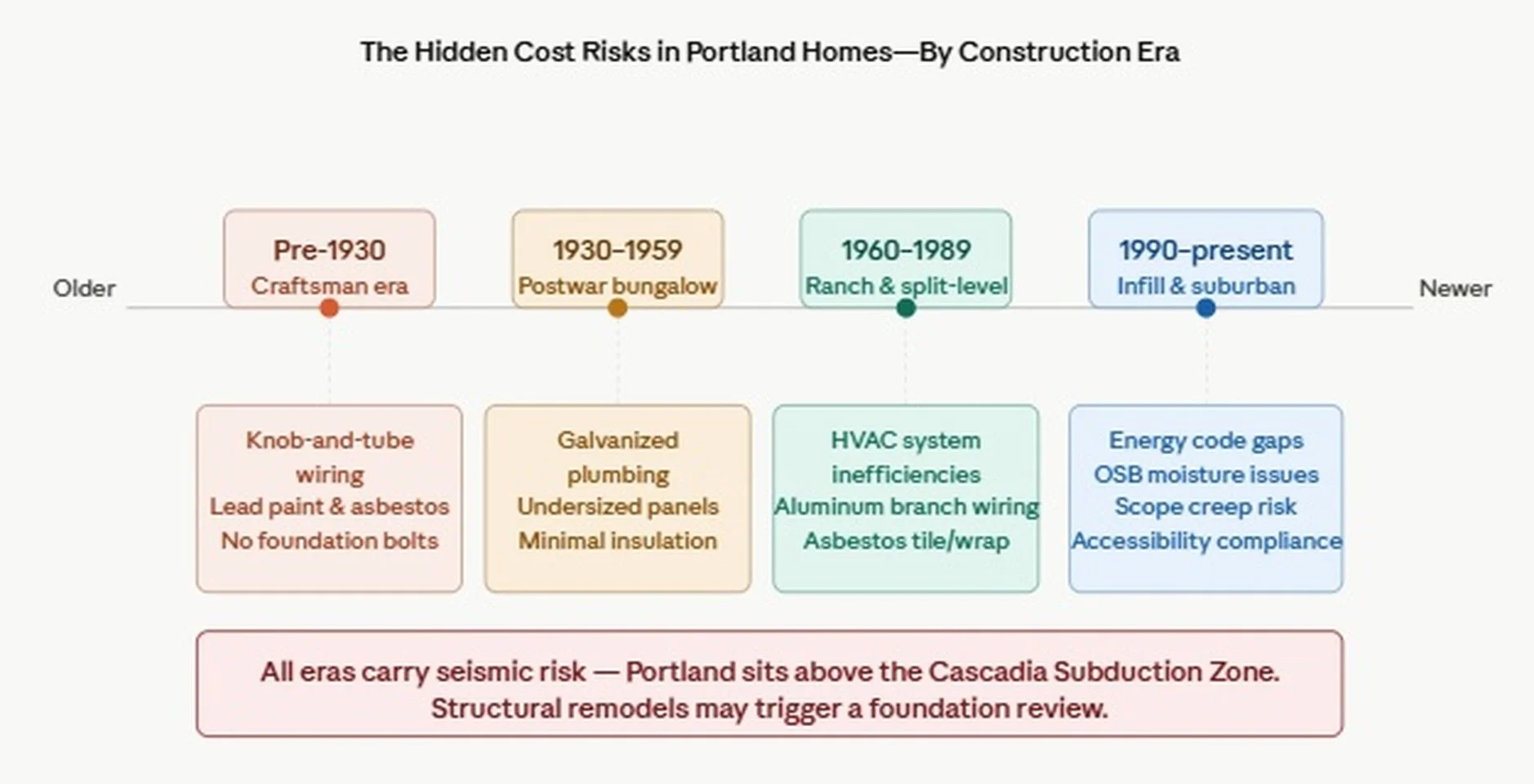
Timeline of Portland construction history highlighting once-accepted building techniques that now drive hidden costs and budget overruns in renovation projects
This article is part of a three-part series on remodel cost overruns:
[Read the general overview: The 3 Biggest Risks That Cause Remodel Cost Overruns]
In Portland, the three biggest cost risks are older existing conditions, permit and code triggers, and the gap between design intent and construction execution.
Risk #1: Incomplete Scope—Especially in Portland’s Older Housing Stock
Incomplete scope is one of the most common causes of remodel cost overruns. In Portland, that risk is amplified by the age and character of the housing stock.
Many Portland homes were built decades ago and may include undocumented additions, aging electrical systems, limited insulation, original framing conditions, or prior work that was never clearly recorded. When a remodel opens walls in an older Portland home, what is discovered often does not match what was assumed.
The core issue is that many projects begin with concept-level plans and general assumptions rather than verified existing conditions. At that stage, the project may feel defined. But critical information is still missing.
If the scope is not fully resolved before construction, it will be resolved during construction—at a higher cost and on a compressed timeline.
The practical fix is to invest in the front end. A pre-construction conditions assessment, even a focused one, gives the owner and contractor real information to price against. For older Portland homes especially, what is behind the drywall should be understood before construction pricing is treated as reliable.
Risk #2: Portland Permitting and Code Triggers
Permitting in Portland is not just a formality. It is where project assumptions—often developed during early residential design—are tested against actual code requirements.
This is where scope can expand.
A few Portland realities matter:
Structural and seismic conditions. Portland is located in a region affected by the Cascadia Subduction Zone. For many single-family remodels, full seismic upgrades are not automatically required, but structural work, additions, foundation work, or major alterations can bring existing structural conditions into the review conversation.
Energy compliance. Remodels that affect the building envelope, mechanical systems, windows, insulation, or conditioned space may trigger current energy-code requirements. In an older home, those requirements can add cost if they were not anticipated during design.
FIR availability. Portland’s Field Issuance Remodel program can streamline certain residential remodel permits for qualified participants, but the program is not currently open to new applicants. Owners should not assume their project will qualify for that pathway unless their contractor or design professional already participates.
Review timelines. Some permits can be reviewed quickly, but additions, ADUs, structural changes, and more complex remodels may require full plan review. Permit delays can affect construction sequencing, contractor availability, and overall cost.
Permitting in Portland does not just approve the project. It can reshape the project.
The best way to reduce this risk is to address code and permitting issues during design—not after permit submittal. An architect or design professional familiar with Portland’s residential code environment can identify likely triggers before they become expensive surprises.
Risk #3: Disconnect Between Design and Construction
Even when the scope is strong and permits are in hand, projects can break down during construction.
This usually happens when there is a gap between what is drawn, what is intended, and what actually gets built.
In Portland remodels, this risk is common because existing homes rarely behave like new construction. Irregular framing, non-standard dimensions, old mechanical runs, low clearances, previous alterations, and concealed conditions can all force field decisions.
When those decisions are made without design oversight, the project can drift away from the original intent. That can lead to rework, change orders, schedule delays, and quality compromises.
The specific failure points often include:
Missing or ambiguous details in the drawing set
Assemblies that are difficult to build as drawn
Mechanical, electrical, plumbing, and structural conflicts
Field changes that are not coordinated before work proceeds
Owner decisions made under pressure during construction
This is where owner’s representation can be valuable. An experienced owner’s representative can help protect design intent, coordinate between contractor and design team, review issues before they become expensive, and keep the project focused on cost-effective execution without sacrificing quality.
Without alignment between what is designed and what is built, cost overruns become much more likely.
Why These Risks Stack
These risks rarely happen in isolation.
A typical Portland remodel cost-overrun pattern looks like this:
The project scope is based on visible conditions only
Permit review identifies code or structural issues
Design changes are required
The contractor reprices the work
Construction starts with unresolved coordination issues
Field conditions trigger more decisions and change orders
The cost does not come from one single problem. It comes from the cascade.
That is why the broader principles in Why Residential Projects in Portland Go Over Budget — and How to Prevent It are especially important in Portland. The risks are the same, but the local conditions make them more consequential.
How to Prevent Cost Overruns on a Portland Remodel
The goal is not to eliminate every change. That is unrealistic.
The goal is to control when change happens.
Changes made during planning are relatively inexpensive. Changes made after permit approval cost more. Changes made during construction cost the most.
The strategies that consistently help are:
Assess existing conditions before design begins
Identify likely permit and code triggers early
Develop drawings that are detailed enough to price and build
Coordinate design decisions before construction starts
Use owner’s representation or construction-phase oversight on complex projects
Early involvement from an architect or owner’s representative is not just about better drawings. It is about reducing uncertainty before uncertainty becomes a change order.
Conclusion
Remodel cost overruns in Portland are predictable.
They usually come from incomplete scope, local permit and code triggers, and the gap between design intent and field execution.
Each of these risks can be addressed early. The question is whether they are addressed proactively during planning or reactively during construction.
For a broader overview of these same risks, read:
[The 3 Biggest Risks That Cause Remodel Cost Overruns]
For the Washington County version of this article, read:
[The 3 Biggest Risks That Cause Remodel Cost Overruns in Washington County]
For a deeper look at how these issues affect residential construction budgets, download our white paper:
[The Hidden Cost Drivers in Portland Residential Construction]
