
Why ADUs in Portland Cost More Than Expected
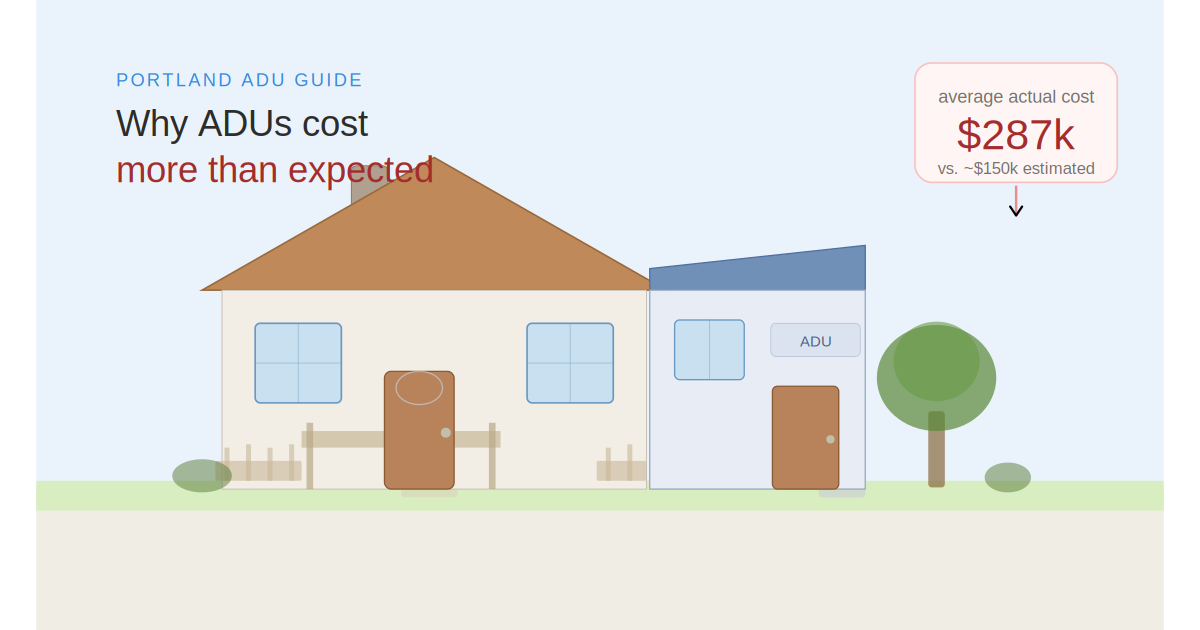
Many Portland homeowners underestimate ADU costs by 40–90%. Site constraints, permitting, and utility work are the biggest culprits.
Many homeowners begin exploring an Accessory Dwelling Unit with a straightforward assumption: "It's a small building, so it should be relatively affordable." Unfortunately, many Portland ADU projects end up costing more than expected.
That doesn't necessarily mean the project was poorly planned or that contractors made mistakes. In many cases, cost increases happen because homeowners encounter site conditions, permitting requirements, utility needs, or construction realities that were never fully understood during early planning.
The better question is often not: "How much does an ADU cost?" — but rather: "What causes ADU budgets to increase after planning begins?"
Understanding these cost drivers early can help homeowners set realistic expectations, avoid unnecessary redesign, and make better project decisions.
Why ADU budgets often change
Every property is different. A detached ADU behind a flat lot with simple utility access may look very different financially than a garage conversion on a steep site with drainage concerns. Many of the biggest cost increases come from conditions that are hidden until feasibility review, design, permitting, or construction begins. This is one reason why early planning often matters more than homeowners expect.
1. Site work and existing property conditions
One of the largest drivers of unexpected cost is the site itself. What appears to be a simple backyard project may involve significant work below grade or around the property.
Grading and slope
Steep lots may require excavation, retaining walls, additional drainage systems, and specialized foundations. Even moderate grade changes can affect project cost.
Site access challenges
Limited backyard access can affect excavation equipment, material staging, labor productivity, and construction sequencing. In dense Portland neighborhoods, access constraints can significantly influence construction cost.
Existing conditions
Older properties may contain aging utilities, drainage deficiencies, outdated electrical systems, and existing structures requiring upgrades — often discovered only after design begins.
2. Utility costs are frequently underestimated
Utility work is one of the most common reasons ADU budgets increase. Many homeowners assume utilities are already available because the primary house exists. In reality, connecting a detached ADU often involves additional scope:
Sewer work and lateral upgrades
Water service coordination
Electrical panel capacity increases
Trenching across the property
The required work depends heavily on site layout, existing infrastructure, and project scope. In some cases, utility improvements become one of the larger line items in the budget.
3. Stormwater and impervious surface impacts
Portland homeowners are often surprised to learn that adding an ADU may affect stormwater requirements. New development can increase impervious area through new roof area, walkways, patios, expanded driveways, and parking areas — each of which may introduce stormwater management considerations depending on site conditions and project scope. This is one of the more commonly overlooked early planning issues.
4. Tree preservation requirements
Trees can significantly influence ADU feasibility and cost. Depending on the property, tree preservation requirements may affect ADU placement, building size, site layout, and excavation zones. Tree mitigation, redesign, or placement limitations may become necessary — making trees one of the most important early feasibility considerations on some sites.
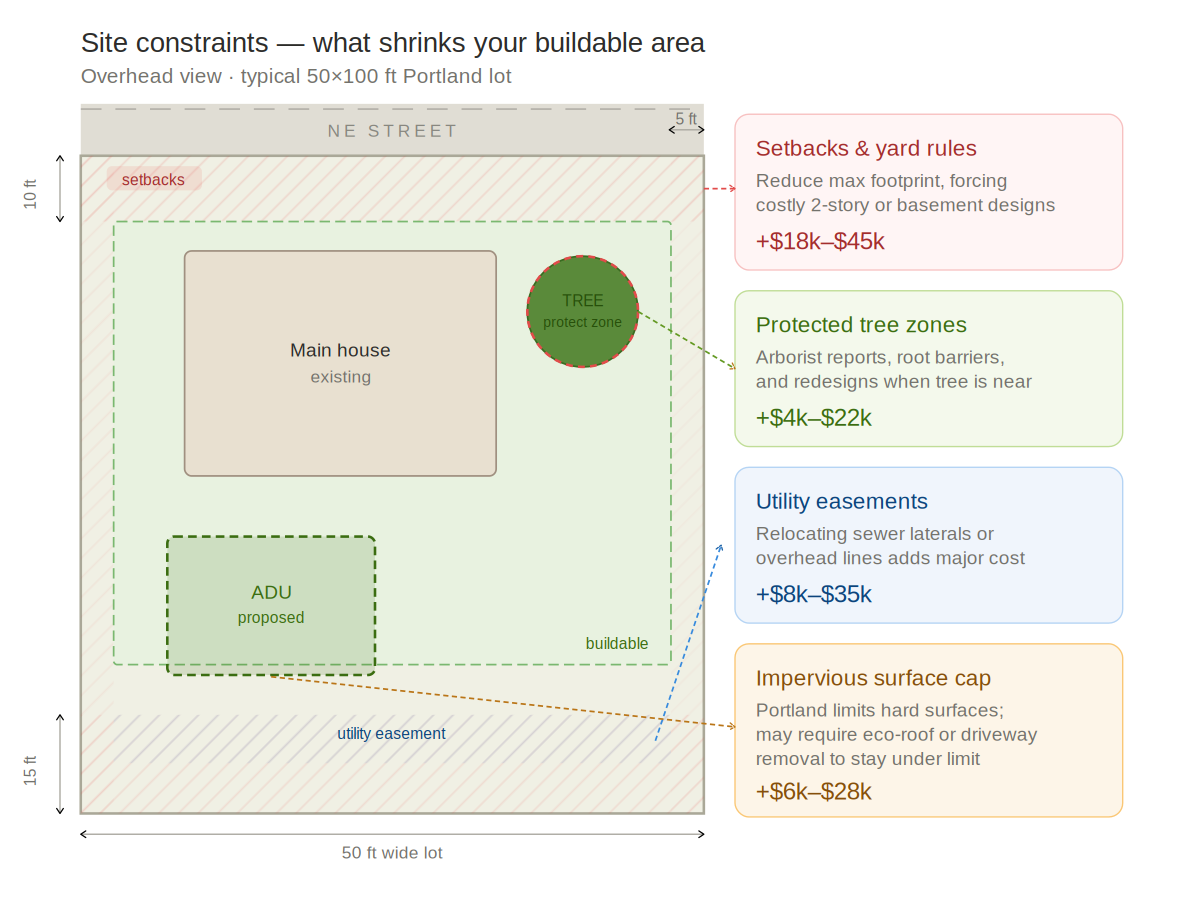
A typical 50-ft Portland lot can lose 30–40% of its buildable area to setbacks, easements, and tree protection zones — each with real cost consequences.
5. Existing garage or basement conditions
Garage conversion ADUs often appear less expensive at first glance — and sometimes they are. However, existing structures frequently contain hidden conditions including structural deficiencies, foundation limitations, moisture issues, ceiling height concerns, fire separation requirements, and framing upgrades. What appears to be a simple conversion can quickly become more involved once construction begins.
6. Permit delays and design revisions
Time has cost implications. Projects that experience permitting delays may also face construction cost escalation, additional consultant time, redesign costs, and contractor repricing. Delays are not always caused by City review alone — in many cases, schedule impacts occur because zoning assumptions, utility issues, or code concerns were not identified early.
7. Scope growth during design
This is extremely common. Many homeowners begin with a modest ADU concept and later decide to upgrade finishes, add storage, raise ceiling heights, improve windows, add covered outdoor areas, or improve energy performance. As the project becomes more refined, the budget naturally evolves. This is not necessarily a problem — but it is important to anticipate.
The biggest cost driver is often assumptions
In many cases, ADU budgets increase not because of a single major issue, but because of a series of small assumptions that compound over time:
"Utilities should already be there."
"The backyard looks flat."
"The garage just needs finishing."
"Permitting should be straightforward."
Sometimes these assumptions prove true. Other times, they become meaningful cost drivers. Early feasibility and planning help reduce those surprises.
How homeowners can better control ADU costs
No project is completely predictable. However, homeowners can often improve cost certainty by:
Starting with feasibility — understand zoning, utilities, stormwater, site conditions, and permitting risks before design progresses
Aligning scope with budget — set realistic priorities early - Check out: Detached ADU vs. garage conversion in Portland: which makes more sense?
Understanding existing conditions — especially for garage conversions and remodel-based ADUs
Expecting some unknowns — older homes and urban sites naturally contain uncertainty
The goal is not eliminating all risk. The goal is reducing avoidable surprises.
Final thoughts
ADUs in Portland often cost more than homeowners initially expect — not because projects fail, but because property conditions, permitting requirements, utilities, and construction realities become clearer during planning. Many of the most expensive surprises are easier to identify before design begins.
For homeowners considering an ADU in Portland, thoughtful planning and early feasibility analysis often lead to a smoother and more predictable project.
Considering an ADU on your property?
Consider Owners Representation for your to protect your investment or check out our residential services.
For more information download our white paper, The Hidden Cost Drivers in Portland Residential Construction.
