
Permit Fees in Oregon: Plan Review, Reinspection, SDCs, and Other Costs That Surprise Owners
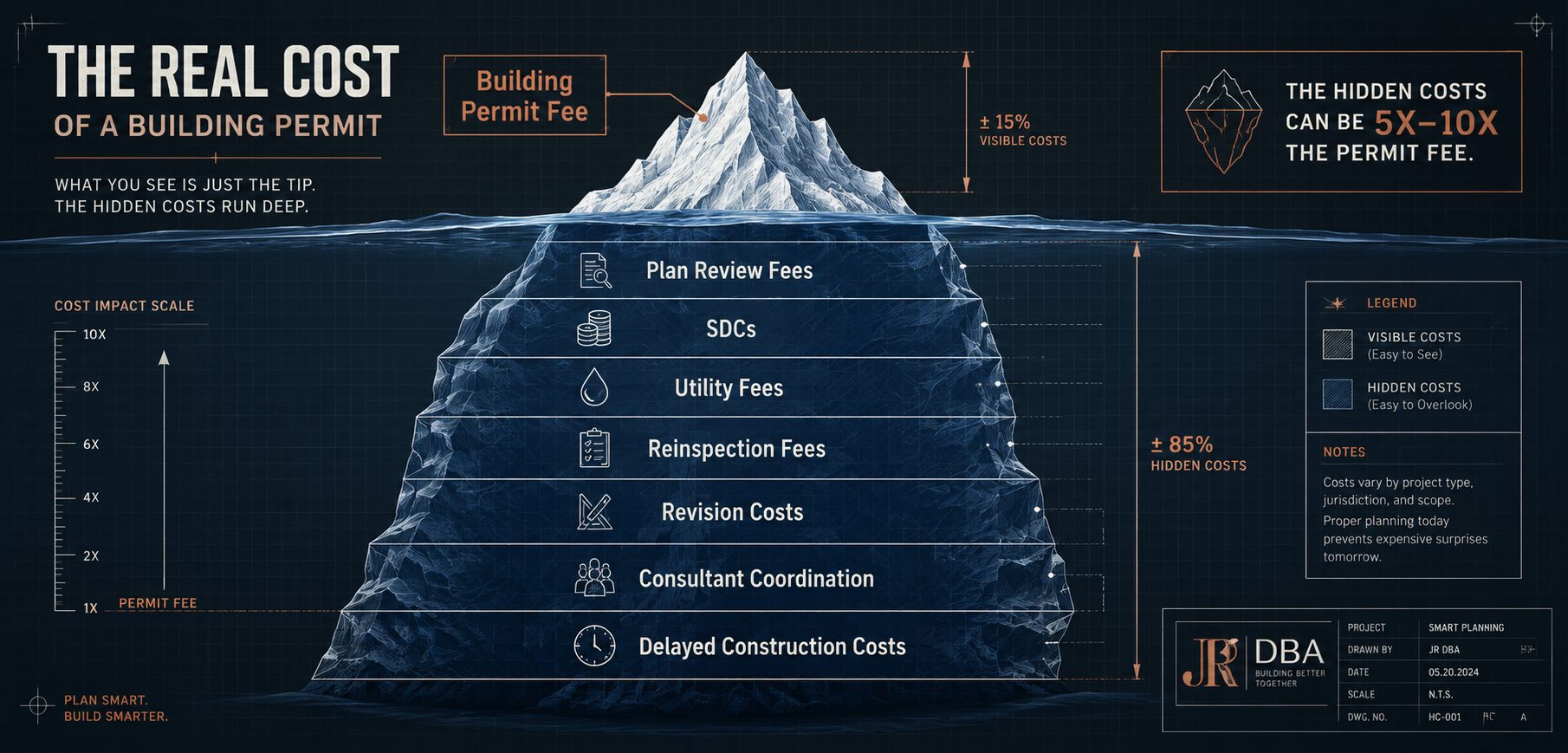
The building permit itself is usually the smallest line on the receipt. It’s everything stacked around it that reshapes a budget.
Every few weeks I sit down with an owner who has done their homework. They've looked up their jurisdiction's fee schedule, found the building permit fee table, run their project valuation through it, and arrived at a number. It's a reasonable number. It's also often only a fraction of what they'll actually pay before the permit is in hand.
That's not because anyone hid the ball. It's because "permit fees" in Oregon are not one fee. They're a stack: the building permit, the plan review fee, separate trade permits, a 12% state surcharge on nearly all of it, construction excise taxes, and — the one that reshapes budgets more than any other — system development charges. Each piece is published, legal, and predictable if you know to look for it. Almost nobody looks for all of it.
This post walks through the full stack the way I walk clients through it: what each fee is, who collects it, when it's due, and where the genuine surprises tend to hide. I'll use Portland and Washington County examples throughout, because that's where I work and because the two jurisdictions illustrate how differently the same categories of fees can land.
This post assumes your project has already cleared land use. If you're not sure whether your project needs land use review before a building permit — or why those are two separate processes with two separate fee schedules — start with the first post in this series:
Land Use First, Building Permit Second.
How Oregon permit fees are actually structured
Oregon's building permit system is state-governed but locally administered. The Building Codes Division (BCD) sets the code framework, and each city or county building department adopts its own fee schedule to fund plan review and inspection operations. Most jurisdictions update those schedules effective July 1, which means the numbers you found last fall may already be out of date.
The core building permit fee is almost always valuation-based: the jurisdiction takes your project's construction value — either your stated value or their own square-footage-based calculation, whichever they deem accurate — and runs it through a tiered table. Higher valuation, higher fee, on a declining marginal rate. This is why the valuation you declare on your application matters, and why understating it doesn't help you: plans examiners check valuations against published cost data, and a corrected valuation means corrected fees.
What the fee table doesn't tell you is that the building permit fee is the seed number from which several other fees grow. Plan review is typically calculated as a percentage of it. The state surcharge is calculated on top of it. And it covers only the structural work — plumbing, mechanical, and electrical each carry their own permits with their own fee tables.
Plan review: the fee you pay whether or not you build
Plan review fees in most Oregon jurisdictions run around 65% of the building permit fee, charged at intake — before a single sheet has been reviewed. This is the fee that funds the plans examiner's time, and it's generally non-refundable. If your project dies in review, or you abandon it after approval, the plan review fee stays spent. The work was performed.
I wrote in detail about how checksheets and resubmittals work — and how to engineer them out of your timeline — in The Three Biggest Risks That Cause Remodel Cost Overruns in Portland. The mechanics apply well beyond ADUs.
Two things about plan review fees catch owners off guard. First, complex projects can accrue additional plan review charges: fire and life safety review on commercial work, phased submittals, deferred submittals (trusses, fire sprinklers, storefront systems), and revision reviews are all commonly billed as separate line items or hourly charges. Second — and this is where fee exposure and schedule exposure become the same problem — every checksheet cycle costs you. Some jurisdictions bill hourly for review of resubmittals beyond a set allowance. Even where they don't, each round of resubmittal is weeks of carrying cost on your construction loan, your consultants, and your escalation exposure.
A clean first submittal isn't just faster. It's cheaper, in ways that never show up on the fee schedule.
The 12% state surcharge
For building, plumbing, mechanical, electrical, and other state building-code permit items in Oregon, a 12% state surcharge is added to the applicable local permit fee. It does not make every development charge 12% higher — SDCs, CETs, and many utility charges are separate — but it does apply broadly across the permit and inspection fee items owners are already budgeting for: building and trade permits, plan review, reinspections, and additional inspections. The surcharge funds the Building Codes Division — the agency that writes and maintains the ORSC and OSSC — and it applies statewide, in every jurisdiction. It's not negotiable and it's not a local policy choice.
Twelve percent sounds modest until you total the items it touches. On a project carrying $20,000 in combined permit and plan review fees, that's another $2,400 that most first-time owners never budgeted, because it appears nowhere in the local fee tables they studied.
Trade permits stack — they don't bundle
Oregon jurisdictions issue separate permits for building (structural), plumbing, mechanical, and electrical work. Each has its own fee methodology: plumbing is often priced per fixture, mechanical per appliance or by valuation, electrical by service size and circuit count. On a whole-house remodel or a new dwelling, the trade permits together can rival the building permit itself — and every one of them carries the 12% surcharge.
When a contractor's bid says "permits by owner" or carries a single allowance line for permits, this stack is what that allowance has to cover. I've reviewed plenty of bids where the permit allowance would not have covered the trade permits alone, let alone what comes next.
Bid review before you sign. Part of my bid-leveling work is testing every allowance in a contractor's proposal against real jurisdiction fee schedules and real SDC exposure — before the contract is signed, not after the first invoice. If you're comparing bids and the permit lines don't match, that's usually a scope gap, not a savings.
Reinspection fees and the cost of failing twice
Every permit includes inspections in its base fee — but not unlimited inspections. When work isn't ready, isn't accessible, or fails the same correction twice, jurisdictions charge reinspection fees, typically billed hourly at the department's published rate. Portland, Washington County, and the Washington County cities all carry reinspection provisions in their fee schedules.
The fee itself is rarely the real cost. A failed framing inspection that takes eight days to re-schedule is eight days of general conditions, eight days of schedule compression somewhere downstream, and — on occupied remodels — eight more days your client is living in a construction zone. On projects where I'm engaged for construction-phase advocacy, inspection readiness is a standing agenda item at every OAC meeting for exactly this reason: the cheapest inspection is the one that passes the first time.
Related inspection costs worth budgeting on the right project: after-hours or expedited inspection requests (hourly, usually with a minimum), special inspections required by the structural design (billed by private agencies, not the jurisdiction — and often five figures on commercial work), and permit reactivation fees when a permit lapses because 180 days passed without an approved inspection.
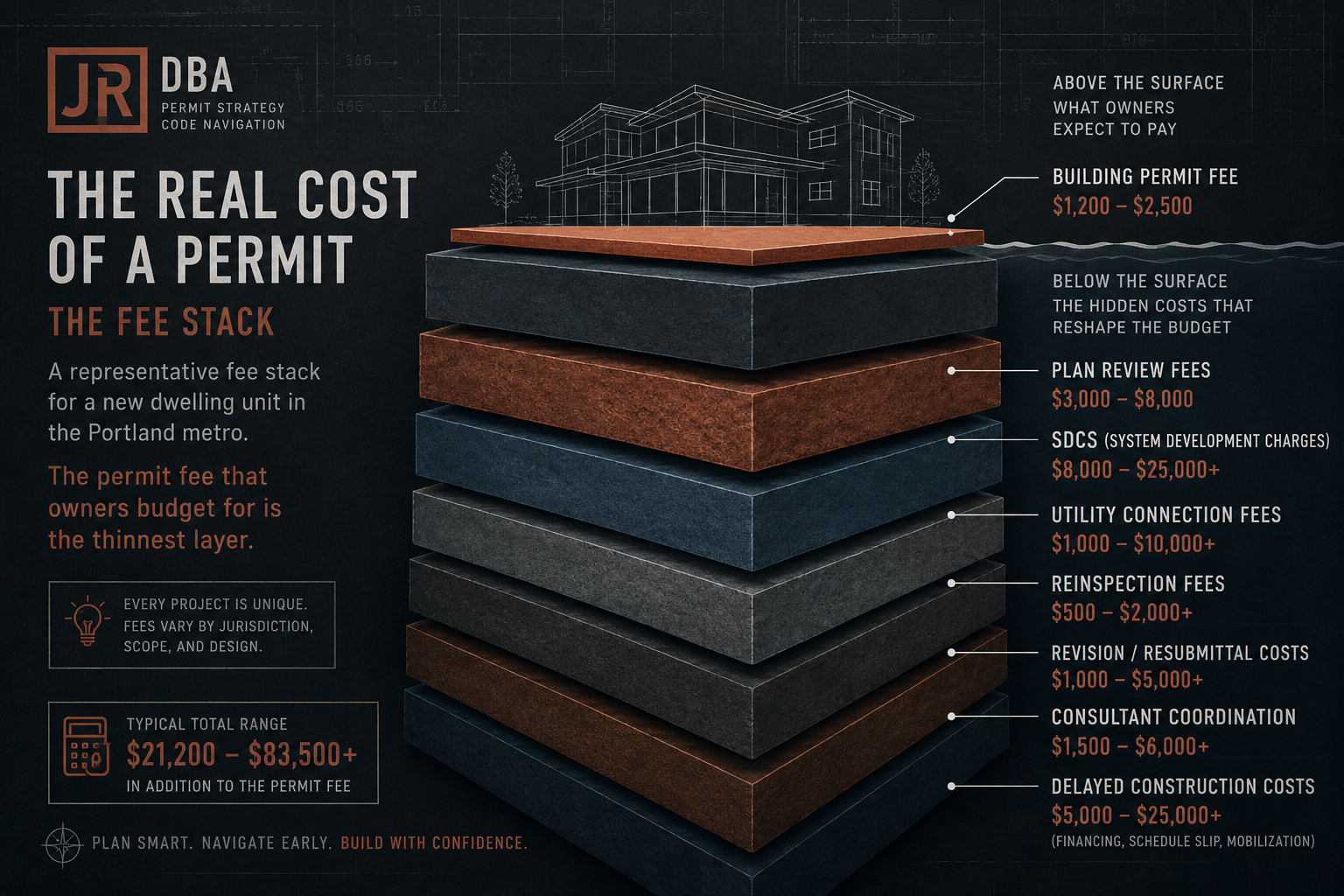
A representative fee stack for a new dwelling unit in the Portland metro. The permit fee that owners budget for is the thinnest layer.
System development charges: the number that reshapes budgets
If you remember one thing from this post, make it this: system development charges are routinely the largest single line item in the permit fee stack, and they are the least visible from the fee schedules owners actually read.
SDCs are one-time infrastructure charges assessed when new development — or a change in how a property is used — adds demand on public systems. In Portland, up to five separate bureaus assess them: sewer (BES), water, parks, and transportation (PBOT), plus school district charges collected alongside. In Washington County, Clean Water Services assesses sanitary sewer and surface water management SDCs, the county and cities assess the Transportation Development Tax and their own city SDCs, and the water districts add theirs.
Clean Water Services' FY 2026–27 schedule lists a sanitary sewer connection fee of $7,332 per dwelling unit or dwelling-unit equivalent, plus a storm and surface water SDC of $710 per equivalent service unit. For a simple planning example charged one DU/DUE and one ESU, that is $8,042 before city, county, water, transportation, parks, or school charges are added.
Three SDC behaviors surprise owners most:
Change of use triggers SDCs without new square footage. Convert an office to an assembly use, a garage to a dwelling unit, a warehouse to a restaurant — the SDC assessment is based on the increase in demand between the old use and the new one. I see this constantly in my commercial due diligence and feasibility work (7) on conversion and adaptive-reuse projects, where owners assume that because the building already exists, the infrastructure charges were paid long ago. They were — for the old use.
SDCs are generally due at permit issuance, at the rates then in effect. A project that sits in review through a July 1 rate adjustment pays the new rates. Most jurisdictions offer deferral or financing programs (Portland allows payment plans on qualifying SDCs), but deferral is not waiver — and deferred SDCs typically must clear before final occupancy.
The estimate is free; the surprise is not. Portland and most Washington County jurisdictions will produce an SDC estimate before you apply. Almost no one asks. On any project involving new dwelling units, added fixtures, or a change of occupancy, an SDC estimate belongs in feasibility — not in the week before issuance.
SDC relief: two Portland programs worth knowing in 2026
As of July 2026, Portland has two distinct SDC relief programs worth understanding — and owners regularly confuse them.
The ADU SDC Waiver Program waives system development charges on new accessory dwelling units in exchange for a recorded 10-year covenant: the property may not operate any structure — the ADU or the main house — as a short-term rental during the covenant period. Violating or revoking the covenant means repaying the waived charges at 150% of the SDC rates in effect at that time. The program has no expiration date, and for an owner planning a long-term rental or family housing, it remains one of the most concrete dollar-for-dollar incentives in the Portland market.
Feasibility before design. My fixed-fee feasibility studies put the full fee stack — SDCs, CETs, land use fees, and permit costs — on the table before you've committed to a design direction, alongside the zoning and code-path findings that drive them. It's the difference between discovering a five-figure SDC assessment in week two and discovering it the week before issuance.
Separately, in 2025 Portland adopted a temporary SDC exemption for new housing units — a citywide program covering most permits for new dwelling units issued from August 15, 2025 through September 30, 2028, aimed at unlocking 5,000 new units. It excludes ADUs (which have their own program) and transient uses, and it carries its own compliance mechanics: fail to achieve an approved inspection within 12 months of permit issuance without a completion guarantee in place, and the City can terminate the exemption and collect the full charges before occupancy. A later change of use on an exempted unit can also re-trigger collection.
If your project creates dwelling units and your permit will issue inside that window, this exemption may be the single largest number in your pro forma. It is worth structuring your submittal timeline around.
Construction excise taxes: three separate CETs, quietly stacking
Construction excise taxes are the quietest layer in the stack because each one is individually small enough to escape attention.
Metro CET. Assessed at 0.12% of improvement value on permits throughout the Metro region, with projects valued at $100,000 or less exempt. On a $600,000 project, that's $720 — real money, but rarely the surprise.
School CETs. Under 2007's SB 1036, Oregon school districts may tax new residential and non-residential square footage on a per-square-foot basis, collected by the permitting jurisdiction. Rates are indexed and vary by district — and in Washington County, where a single project can sit in one of several districts, this is one more reason the same project costs different amounts in Hillsboro, Beaverton, and Sherwood.
Portland's Affordable Housing CET. Inside Portland, residential and commercial projects with improvements valued at $100,000 or more pay an additional 1% of permit valuation. On that same $600,000 project, that's $6,000 — assessed by a city, on top of the Metro CET, on top of the school CET. This is the fee stacking I flag for every client comparing a Portland site against a Washington County site: the categories are the same, but the totals diverge meaningfully.
The rest of the stack: fees that show up by surprise
Here is a partial field guide to the permit-related line items I most often see missing from owner budgets. This is not a complete list, and the items vary by jurisdiction, project type, and site conditions, but these are common sources of surprise:
Land use and planning review fees — often a separate fee schedule and frequently paid before the building permit process even begins.
Erosion control permits and inspections — in Washington County, these are commonly tied to Clean Water Services standards and requirements.
Addressing fees — a smaller line item, but still one that can appear outside the basic building permit fee.
Water meter and service installation charges — typically set by the water bureau, utility district, or service provider, not by the building department.
Fire marshal plan review fees — especially relevant for commercial work, change-of-use projects, and some tenant improvements.
Right-of-way and driveway approach permits — often required when work affects sidewalks, curbs, driveway connections, or public frontage.
Sewer permit and inspection fees — for projects connecting to sewer in Clean Water Services territory, these can ride alongside SDCs and add another layer to the total permit-related cost.
None of these is large on its own. Together, on a modest commercial tenant improvement or a new dwelling, they routinely add thousands — and each one arrives from a different counter, on a different invoice, at a different point in the process.
How to budget for all of this
Permit fees are one half of the budget picture; construction costs are the other. For current Portland-market construction cost ranges by project type — and the local code and labor factors driving them — see How Much Does It Cost to Remodel a Home in Portland?
After twenty-five years of watching these numbers land on real projects, my guidance is consistent:
Get written fee estimates during feasibility, not at application. Portland and the Washington County jurisdictions will estimate permit fees and SDCs from a project description. Ask for them in writing and date-stamp them — schedules change every July 1.
Budget the stack, not the table. As a planning-level rule of thumb for the Portland metro, the full permit fee stack on projects creating new dwelling units or changing use commonly lands well into five figures once SDCs are counted — sometimes 5–10% of construction value on smaller projects. The building permit table alone will never tell you that.
Treat SDC relief programs as schedule drivers. If a waiver or exemption window applies to your project, the date your permit issues — not the date you apply — is what qualifies you. That makes checksheet management a financial strategy, not just a scheduling one.
Ask what's refundable before you pay it. Plan review fees generally aren't. Permit fees sometimes partially are, if no work occurred. SDCs paid on a project that never builds usually are. Knowing the refund posture changes how you sequence payments on a project with open contingencies.
The building permit is rarely the biggest number on the receipt. It's just the first one you see. Owners who understand the full stack early make different — and better — decisions about site selection, project scope, and timing. That's not fee avoidance; every one of these charges is lawful and most fund things your project genuinely depends on. It's fee visibility, and it's one of the most concrete pieces of value a permit consultant brings to the table before design ever starts.
"The building permit is rarely the biggest number on the receipt. It's just the first one you see."
Joshua Richards, AIA, is the principal of JR-DBA, a Portland-based practice providing architectural design, owner's representation, and permit consulting (5) across the Portland metro and Washington County. If you're budgeting a project and want the full fee picture — permit costs, SDCs, and the relief programs your project may qualify for — before you commit to a design, reach out at Joshua@jr-dba.com or 971.217.7967, or learn more at jr-dba.com.
Building Code and Permit Support series:
Oregon ADU Permit Timeline: How to Reduce Checksheets and Resubmittals
Permit Fees in Oregon: Plan Review, Reinspection, SDCs, and Other Costs That Surprise Owners (this post)
Appeals, Variances, and Alternate Methods (coming soon)
